

Fifty years is enough time to build an impressive legacy, but also enough time to learn how to hide behind it. Over the past decade, U2 have been much better at reminding the world of their greatness than at recording music capable of sustaining it. This time, however, it is difficult to reduce everything to yet another anniversary campaign. Released today, November 13, 2026 via Island Records, „Carnaval De Luz” is the band’s sixteenth studio album. It is also their first full-length collection of entirely new songs in nine years. Twelve new tracks arrive in the group’s fiftieth year of existence. The carnival of the title, however, does not represent carefree celebration in a world free of problems. Instead, band suggest that in the face of growing anxiety, we might try to reclaim joy, energy, and a sense of community. It is the kind of idea that could easily collapse into a collection of lofty slogans. The good news is that, this time, the music is usually stronger than the declarations.
There is no point pretending that the past several years have been an uninterrupted artistic success for U2. „Songs of Experience” contained some strong moments, but it did little to dispel the impression that the band was caught between its own identity and an urge to appeal to contemporary audiences. „Songs of Surrender” revisited the classic catalog in new arrangements, not always to the benefit of the songs themselves. Spectacular tours and the technological extravaganza of the Sphere mainly proved that the quartet could still operate as a major live institution. What was less obvious was whether they remained equally convincing as a studio band. Larry Mullen Jr.’s health problems did not help, especially after he was absent from the Las Vegas shows. He is hardly the kind of member who can be replaced without consequence. The foundation of U2 has always rested on the dialogue between his drums, Adam Clayton’s bass, and The Edge’s guitar. Mullen now describes recording an album in the band’s fiftieth year as a kind of validation of the youthful ideas shared by four people who formed a group because they wanted to change the world. In the end, they may not have changed it to the extent they once imagined, but after half a century they have not lost the need to create together.
The first signs of change appeared at the beginning of 2026. Released on Ash Wednesday, „Days of Ash”, which I reviewed for SztukMix, presented U2 as chroniclers of crisis. The band focused on victims of violence and a world descending into chaos rather than stadium-sized declarations. The material was cohesive and sincere, though musically fairly conservative. Six weeks later, „Easter Lily” turned toward more personal themes: friendship, faith, loss, and renewal. Only with today’s release of „Carnaval De Luz” does the full concept become clear. Bono openly admits that all of this material came from a single creative cycle that ultimately grew too large for one album. The two EPs therefore brought important pieces of that story into the light ahead of time. The chronology is deliberately reversed. Carnival leads to Lent, and Lent to Easter – from the celebration of the body through a period of restraint and reflection to the possibility of renewal. Musically, the transition is just as clear: the ending of „COEXIST (I Will Bless the Lord at All Times?)” leads into „Go (Carnaval de luz)”, while the conclusion of the main album opens the way toward the songs already known from the EPs. In this way, the twenty-four recordings begin to function almost like one extended, two-part album. Suddenly, what only a few months ago looked like a series of separate releases reveals itself as a far more carefully constructed whole.
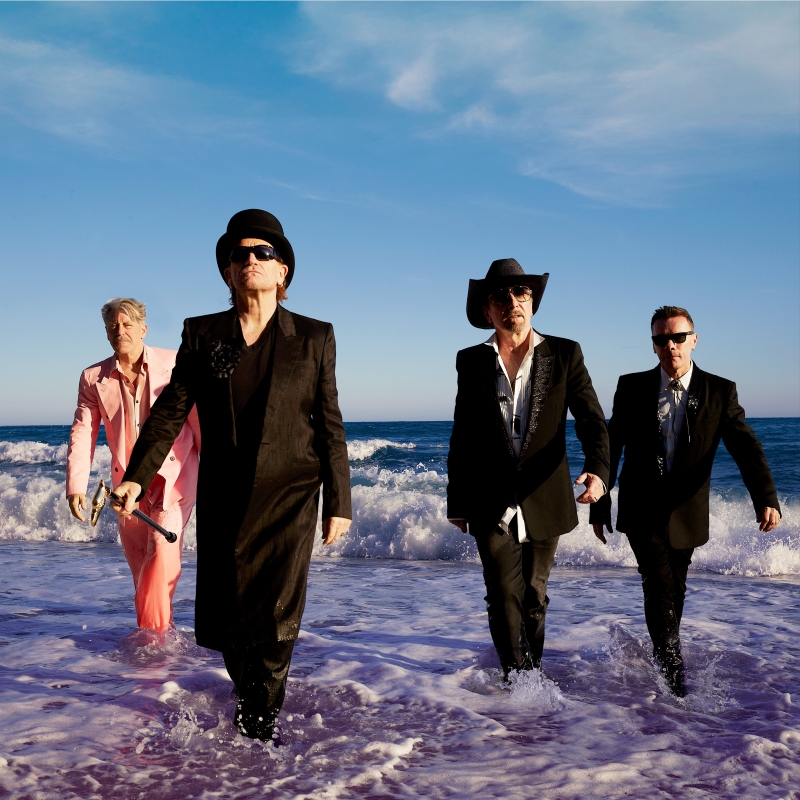
„Carnaval De Luz” works above all because U2 finally stop behaving as though every new song has to compete with the monuments of their own past. We are not getting another „Achtung Baby” or „The Joshua Tree” – and thank God for that. Instead of trying to recreate former greatness, the band delivers material that feels alive, melodic, and surprisingly free. Interestingly, some of that freshness comes from a return to simplicity. The Edge talks about breaking apart the band’s traditional working methods: the musicians recorded together, separately, and in different configurations, allowing the songs themselves to determine the direction. Bono, meanwhile, points to the minimalism of the early Police albums and Nirvana, reminding us that the power of a recording does not always come from the number of tracks layered on top of one another. You can also hear a fascination with space and texture reminiscent of „The Unforgettable Fire”. On top of that come influences U2 previously approached much more cautiously. Larry Mullen Jr. worked on breaking Latin rhythms down into their individual components, while Adam Clayton admits he had been listening to a lot of soca. That pulse is especially evident in „Street of Dreams”. The carnival therefore becomes more than a lyrical concept – it is also a way of thinking about rhythm, community, and music as something capable of bringing people together in one place.
The best songs confirm that expanding the band’s language in this way made sense. Opener „Go (Carnaval de luz)”, co-written with Brian Eno, is sharp, danceable, and refreshingly free of mandatory solemnity. „La reina” is built around a strong riff and pulsing bass line, but it also has a specific carnival reference: the tradition of choosing an ordinary participant to serve as queen of the parade for a single day. The song that speaks to me most, however, is „The Mirror Maker (Rosalía)”. Bono was inspired by his fascination with an artist who, in his view, moves simultaneously through the physical and metaphysical worlds, while exploring her own Catholicism in a fresh way. Rosalía herself has heard the song and, according to Bono, responded very positively. More importantly, the track captures the spirit of classic U2 without reheating old ideas. Modern rhythms and pop openness do not push aside the band’s characteristic sense of guitar space. I rate „Silencio” just as highly. It is short, direct, and almost punk in spirit, with Bono openly describing it as a small tribute to the Ramones. This is exactly the kind of simplicity U2 have sometimes lacked in recent years. „The Greatest Show on Earth” reaches for greater scale, while „Can’t Stop Us Now” makes excellent use of the rhythm section’s pulse. The strongest moment, however, was saved for last. „Torn” originally grew out of an idea by Dolly Parton before U2 transformed it into a song of their own. Mullen even describes the track as the element that binds the entire album together. Daniel Lanois’ pedal steel adds a deeply affecting delicacy, while the family conflict at the heart of the song takes on the broader dimension of a community falling apart. Much like Johnny Cash once did on „The Wanderer”, Parton allows us to hear U2’s music from a different perspective.
That does not mean, of course, that U2 have suddenly abandoned all of their old habits. Bono can still sound as though every emotion needs to be written in capital letters immediately. His reflections on love, faith, and community also sometimes demand a grander setting than they really need. After five decades, though, it is difficult to expect him to completely abandon his way of expressing himself. What bothers me more are the moments when an impressive form is not matched by an equally strong song. „Superficiality” is the clearest example. The tempo, energy, and accessibility are all there, but the banal chorus disappears almost as quickly as it arrives instead of lodging itself in the memory. I am still not entirely convinced by „Midnight Sunshine”, either. It is not a bad song, but surrounded by the album’s strongest moments, it lacks a more distinct identity. We can therefore still demand greater discipline and sharper selection from U2. The fundamental difference compared with several of their previous releases, however, is that this time we are talking about missteps within a good album rather than a handful of strong songs trying to rescue an average one.
This album will not erase more than a decade of U2’s artistic wandering, nor will it make the quartet the most important rock band in the world again. And that is probably for the best, because the musicians finally seem to have stopped treating that position as an obligation. In discussing this album, The Edge speaks about the need to resist the cynicism and hopelessness that can so easily grow under the constant pressure of daily news. In that context, the carnival of the title stops being an escape from reality. It becomes an attempt to find community, movement, and light within it. After the anxiety of „Days of Ash” and the introspection of „Easter Lily”, we therefore arrive at an album that does not deny suffering or fear, but answers them with energy, closeness, and simple joy. I would even go as far as to say that „Carnaval De Luz” is U2’s best studio album since „How to Dismantle an Atomic Bomb”. Not every chorus stays with you, and Bono still has a tendency toward excess, but the overall balance is clearly in the band’s favor. Bono himself sums up the album in terms of the contrast between weight and light. It is difficult to find a better key to understanding it. U2 have finally made an album that does not need to be defended through nostalgia for „The Joshua Tree” or „Achtung Baby”. It can be defended by the songs themselves. And after all these years, that may be the best news of all.
Szymon Pęczalski