
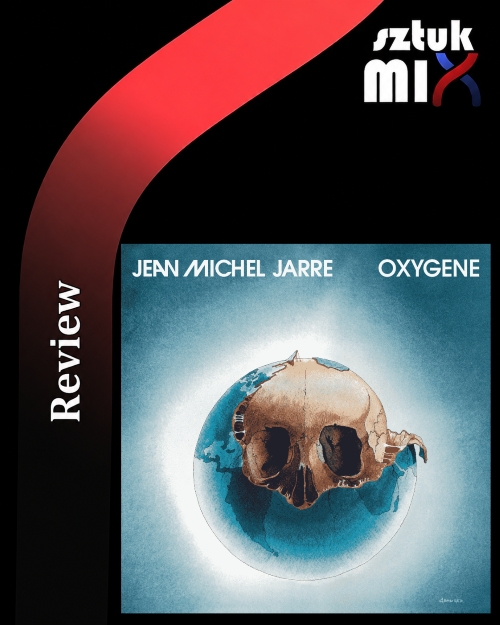
It only takes a few distinctive sounds to enter a world where electronic music stops being a technological curiosity and becomes a fully developed language of emotion. Gently pulsing sequences, spacious soundscapes, and melodies that stay with you for a lifetime – that is the enduring power of Jean-Michel Jarre’s „Oxygène”. For fifty years, the album has continued to captivate new generations of listeners, and despite the passing of time, it can still sound almost futuristic. That becomes even more remarkable when you consider how far removed its recording conditions were from the possibilities of a modern studio. Originally released in December 1976, the album went on to become one of the milestones of electronic music. Now, half a century later, it returns in a newly remastered anniversary edition. It is difficult to imagine a work of this stature genuinely needing to be fixed. Fortunately, this new release does not try to do that. Instead, it allows us to look a little deeper into a world we thought we already knew perfectly well.
The story behind „Oxygène” is every bit as fascinating as the music itself. Jarre did not have access to an impressive studio or the resources of a major label. He recorded the material between August and November 1976 in his Paris apartment, using an eight-track tape recorder and a relatively modest collection of instruments. These included the EMS VCS3 and Synthi AKS, ARP 2600, Eminent 310U organ, Mellotron, and RMI harmonic synthesizer. From machines that demanded patience, hands-on work, and constant experimentation emerged a world that was difficult to compare with almost anything else at the time. Not everyone recognized its potential at first. With no traditional songs, no vocals, and no easy genre classification, the material was rejected by several labels. The album was eventually released in France by Disques Motors, while international distribution the following year opened the door to Jarre’s global career. Over time, „Oxygène” went on to sell around twelve million copies. Michel Granger’s cover art became equally iconic, depicting a skull revealed beneath the surface of the Earth – an image as beautiful as it is unsettling, and one that perfectly complements the ecological undertones of the music.
The anniversary reissue, released on November 20, 2026 by BMG, is more than another excuse to celebrate a historic success. At Abbey Road Studios, Miles Showell returned to the original stereo tapes to create a new transfer and remaster while preserving the recording’s dynamics, depth, and characteristic warmth. Jarre himself emphasized that the aim was not to change „Oxygène”, but to preserve as faithfully as possible the character of what he created in 1976. You can genuinely hear that philosophy in the result. The album has not been aggressively pushed for loudness or artificially smoothed out. Instead, the individual layers have been given a little more space and clarity. The release is available on CD, 180-gram vinyl, limited colored EcoRecord, and digital platforms. The most extensive edition will arrive on Blu-ray on December 4, featuring Dolby Atmos, a new 5.1 mix, a binaural version, and archival material. The immersive mixes were prepared by David Kosten, Steven Wilson, and Jarre himself. The anniversary extends beyond the reissue, too. In the fall of 2027, Jarre will embark on the „Oxygene & Beyond” tour, including stops in Katowice, Łódź, and Gdańsk, while another studio album is expected before then.
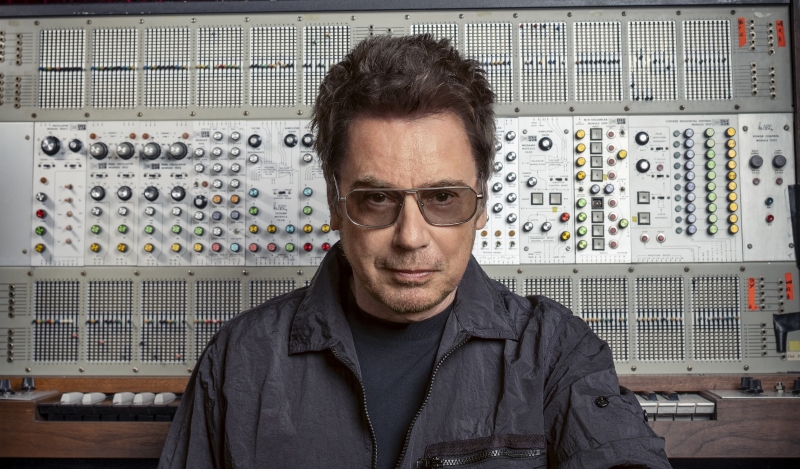
For me, „Oxygène” remains one of those albums that resists simple classification. On the one hand, it feels like an almost cosmic journey through extraordinarily evocative soundscapes; on the other, it can inspire melancholy, unease, and a simple sense of wonder at Jarre’s compositional instincts. Each of the six parts has its own character, but only together do they form the complete story. There is no need here for technical showmanship or for complicating structures simply for the sake of experimentation. Everything serves atmosphere, emotion, and the flow of the musical narrative. Importantly, the new remaster really does allow this music to be heard from a slightly different perspective. I have the impression that there is simply more to hear – tiny effects, the breathing room between layers, and details that once sat deeper within the analog space now emerge more clearly. This is not, of course, a matter of discovering „Oxygène” all over again. It feels more like stepping back into a room you know intimately and suddenly noticing details that had escaped your attention for years. For an album that has been heard for five decades, it is hard to imagine a greater compliment for a remaster.
Another great strength of „Oxygène” is that Jarre never loses control of the atmosphere throughout its nearly forty-minute running time. „Oxygène (Part I)” almost silently opens the door into this world, while „Part II” introduces a more pronounced pulse and some of the album’s most distinctive electronic effects. „Part III” serves as a brief moment to breathe before the composition that would become Jarre’s signature piece. „Oxygène (Part IV)” is an absolute classic – its hypnotic melody still works with astonishing force despite being built from seemingly simple means. Personally, though, I am drawn even more strongly to the ten-minute-plus „Oxygène (Part V)”. This is where I hear most clearly the progressive element I love so much in this music. Shifting structures, gradually developing motifs, and the movement from calmer spaces into more dynamic sequences give the composition an almost suite-like scale. It is not simply a matter of resemblance to progressive rock, but rather a way of thinking about long-form composition – its dramatic arc, its accumulation of tension, and its natural evolution. Closing track „Part VI” restores a more pronounced rhythmic pulse and brings the journey to a perfect conclusion. It is difficult to identify a single accidental moment here, and the new remaster makes it even easier to hear just how precisely all of these elements were woven together.
Can any weaknesses be found in „Oxygène”? When it comes to the compositions themselves, that would be an exceptionally difficult task for me, and probably an unnecessary one. You could certainly argue that some passages develop slowly and that the repetition requires patience from the listener. But that is precisely the essence of the entire project. Jarre was not trying to force the music into radio-friendly structures; he was creating a space where time seems to move according to slightly different rules. The contents of the anniversary edition itself provide more room for discussion. „Oxygène” has already been reissued several times and presented through a variety of sonic formats, so another remaster inevitably has to justify its existence. This one does so through sheer quality, although it is a shame that the most interesting additions – above all Dolby Atmos and the 5.1 mix – have been reserved for the separate, most extensive Blu-ray edition. I also would have welcomed more archival audio material offering a glimpse behind the scenes of how the individual parts were created. These are, however, reservations about the construction of the reissue rather than the album itself. Musically, even after fifty years, „Oxygène” still gives me very little to complain about.
Five decades is almost an entire era in music. Technologies change, trends change, listening habits change, and so do audience expectations, yet some recordings remain remarkably resistant to time. „Oxygène” is one of the finest examples. Jean-Michel Jarre not only demonstrated new possibilities for electronic music, but above all proved that synthesizers could communicate emotion just as effectively as traditional instruments. The anniversary edition reminds us of that ability while also allowing us to return to six familiar compositions and uncover further nuances within them. We do not need new arrangements, additional instruments, or attempts to modernize a work that was already looking far into the future when it was created. It only needs to be allowed to speak for itself. Thousands of electronic albums have appeared over the past half-century, but few have achieved a comparable balance of experimentation, melody, and emotion. „Oxygène” remains a cornerstone of the genre and one of the most important works in the French musician’s catalog. A masterpiece whose greatness needs no anniversary to justify it. And if we are going to celebrate its fiftieth birthday, it is difficult to imagine a better way than hearing just a little more in music we thought we already knew by heart.