
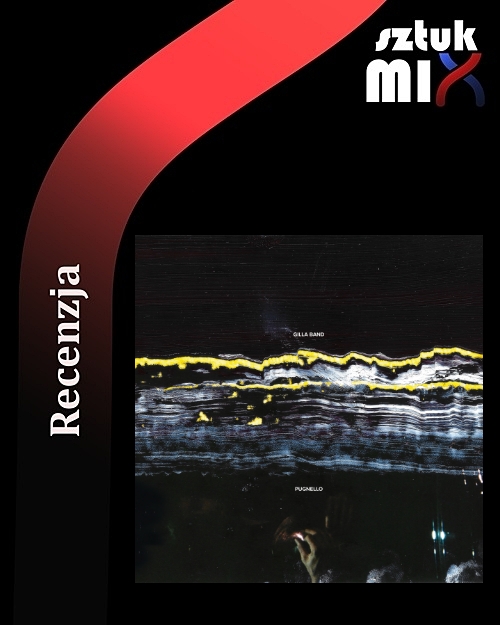
Gilla Band return after four years with a new studio album, their second under the current name and fourth since beginning life as Girl Band. Although the Irish group has until now been associated primarily with guitar-driven music, very little noise rock remains on „Pugnello” – the noise is still very much there, but the rock has almost disappeared. A major reason is the way the band members drifted into different creative directions between the previous album and this one. Vocalist Dara Kiely has recently devoted a great deal of time to painting, which also resulted in the album cover – a failed photograph reworked with oil paint. Guitarist Alan Duggan founded The Null Club, an electronic project built around guest vocalists, bassist Daniel Fox focused on production work for acts including Sprints and Mandy, Indiana, while drummer Adam Faulkner went on tour with Lankum. That separation more or less forced the band to work remotely on the new material, and in the process they began relying increasingly on drum machines while writing. In doing so, they leaned further into techno, a genre whose structures had fascinated them for years. The result is staggering from the very beginning.
A deranged street preacher shouts a mixture of real and invented sayings while, behind him, organic drums combine an accelerated drum-and-bass rhythm with some strange mutation of it. With album opener „The Angelus”, the Irish band almost seems to be filtering its audience from the outset, because not everyone will be brave enough to continue into the remaining forty-two minutes of madness. Those who stay, however, can loosen up a little and dance to the bizarre rhythms of „Placeholder” while Dara continues yelling lyrics that initially sound like nonsense. This time, though, they do share a common thread – all of them relate to his childhood. Rough industrial-noise textures are cooled by the occasional dry cymbal hit as Kiely recalls listening to Coldplay and dreaming of becoming a Power Ranger one day. On „Alogia”, stuttering and other speech limitations caused by schizophrenia collide with minimal techno and an organic rhythm section, producing something fascinating – simultaneously pleasurable and terrifying.
The pace appears to ease in the brief „Three Hands Clapping”, where feedback and electrical crackle hover over droning rumbles. A clock ticking as though slightly too fast makes the track rush by, turning it into an attempted act of communication that ends in failure. The same process repeats, with even worse results, on „Jacobsons”, where Dara spends the entire song trying to speak about grieving his father over the relentless beat of a drum machine. The deeper we go, the more hissing, volatile sounds begin to accumulate, threatening to explode – but in the end it is „only” the vocalist who finally gives way emotionally. The eruption of his screams and abrasive electronic feedback in the finale is so overwhelming that when the madness stops, what remains is not relief but a strange sense of wanting more.
Slowing things down on „Megazord” offers no real chance to recover. The track moves from a deconstruction of dub in its first half into the band’s own vision of slowed-down techno, all of it held together by hissing synthesizers. The preacher comparison returns on „Computer Sadness”, only this time the image is not of someone shouting in the street, but of someone standing at the front of a church. Dara’s heavily processed voice resembles a prayer being sung during a service. Apparently, he was trying to talk about love here, but without much success – his vocal carries grievance, sorrow, and boredom in equal measure, continuing the chain of associations. The first half of „Giraffe”, by contrast, is the album’s most overtly rock-oriented passage. The guitar resembles the kind of instrument heard across broad strains of post-punk and noise rock, the territory where Gilla Band first made their name. The same is true of the vocals, which allow us to hear more clearly and actually understand the words. It is a point where the album’s major themes converge: grief over his father, the loneliness and disorientation tied to that loss, and memories of a difficult childhood.
Although the first half of „Giraffe” sounds more conventional, its second section brings back the pulsing electronic rhythm. That pulse continues into the absurd „Crisp Pop”, whose sheer silliness provides some relief from the emotional weight of everything that came before. Musically, the track is packed with playful little flourishes, while Dara compares Britpop bands to different flavors of potato chips. Why Oasis had to be cheese and onion, however, remains a mystery. The sheer amount of raw electronics accumulated across the album means that closing track „At the Gallop” may initially bring Kraftwerk to mind, although the idea behind it came from somewhere entirely different. The use of vocoder was inspired by Neil Young’s „Trans”, where the instrument was used as part of an attempt to communicate with his severely ill son. Here, Dara is trying to communicate something to himself, adopting the voice of his father and sending warnings from beyond the grave over rhythms that repeatedly surge into motion before abruptly collapsing. Knowing the intention behind the device makes the song even more affecting.
This time around, Gilla Band have made a record that retains very little of the noise-rock and post-punk mixture once so characteristic of their sound. On the other hand, Dara’s voice still makes this acclaimed Irish group instantly recognizable. It is also worth stressing that the choices heard on „Pugnello” do not feel like some temporary whim, but like the natural evolution of a band that was already introducing industrial elements on 2019’s „The Talkies”, still released under the Girl Band name. They moved even further in that direction on „Most Normal” four years ago, where electronics could no longer be described merely as an influence but had already become an integral part of the album’s construction. It feels, however, as though the band has only now expressed itself with complete freedom. On „Pugnello”, conventional guitar arrangements have been pushed almost entirely aside. Paradoxically, I do not think that will cost Gilla Band much of its existing audience – the group’s neurotic, unhinged character has not disappeared inside all this deconstructed techno. The opposite may even happen, with the band gaining new listeners among fans of more experimental music. I would call the move brave, except that it does not really feel like a calculated move at all. It sounds as though Gilla Band simply made exactly the album they needed to make for themselves, without worrying about how anyone else might receive it.