

There are bands that, after enough time has passed, are expected to return to the sound people once fell in love with. Queens of the Stone Age have not belonged in that category for a long time. Josh Homme has steadily moved away from the desert rock he helped shape back in the Kyuss days, although the distinctive, unsettling pulse of his songwriting remains impossible to mistake for anyone else’s. The band’s ninth studio album, „Perfecth”, arrives on October 30, 2026 via Matador Records, and the title itself already makes it clear that this will not be a story about perfection. The extra „h” is a deliberate distortion of a word that promises something Homme believes does not really exist in the first place. This time, the Americans are not trying to cover the cracks with another layer of guitar noise. Quite the opposite: they turn those cracks into the starting point for one of the most personal records in their discography. And although „Perfecth” is far from flawless, accepting those imperfections turns out to be one of its greatest strengths.
The past few years in the Queens of the Stone Age camp have been anything but calm. Released in 2023, „In Times New Roman…” ended a six-year gap following „Villains” and was a tense, forceful, at times almost suffocating record. Beneath its tightly wound guitar surface was a document of a period in which Homme was dealing with serious health issues and a difficult personal situation. The band later returned to the stage, reminding everyone of its formidable live power, but that did not mean the complications were over. In the summer of 2024, Homme’s health forced the cancellation of several shows and required urgent surgery. Under those circumstances, questions about the band’s future stopped feeling like little more than a journalistic device. Looking back, „In Times New Roman…” can be seen as an album made in the very center of a crisis, while „Perfecth” sounds more like an attempt to understand what remains once that crisis has passed.
An important role in that transformation was played by the band’s performance in the Paris Catacombs, recorded in 2024 and later released as „Alive in the Catacombs”. There, the musicians stripped back their usual instrumentation, reducing familiar songs almost to melody, words, and acoustic texture. The experience opened the group up to greater restraint and, above all, to leaving things in the music that they might previously have tried to fix. „Insignificant Other”, recorded near the end of the „In Times New Roman…” sessions, is a good example. The version that made the album was only the second of two takes, preserving small imperfections and the looseness of five musicians reacting to one another in real time. „Perfecth” was recorded in stages across several studios, from New Orleans to Los Angeles, with Homme and Michael Shuman sharing production duties. Holding the whole thing together is the idea of kintsugi – the Japanese art of repairing broken pottery in a way that leaves the cracks visible. It is difficult to imagine a more fitting image for this stage in the history of Queens of the Stone Age.
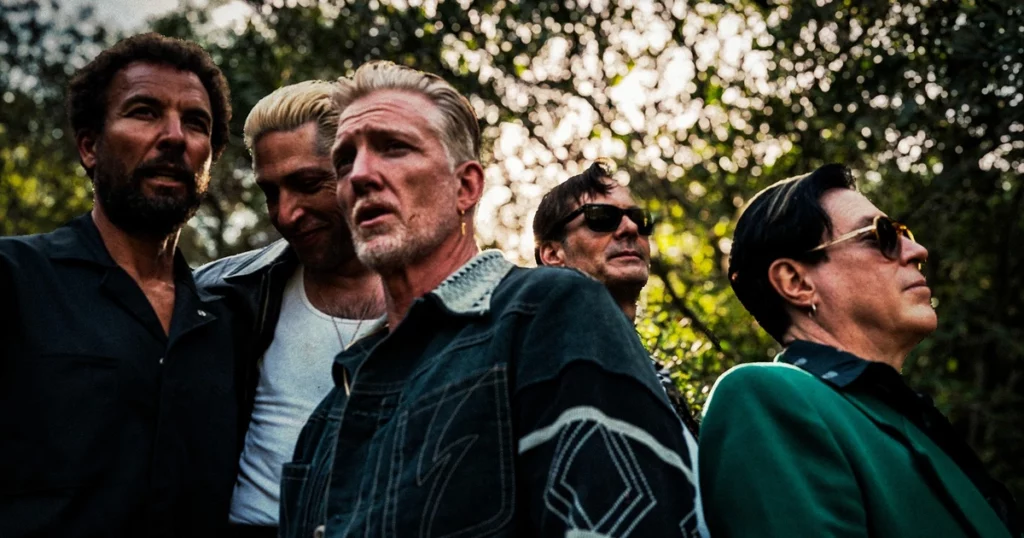
„Perfecth” works above all because it does not try to become another version of „Songs for the Deaf” or „…Like Clockwork”. Its nine songs move between alternative rock, psychedelia, intimacy, and a danceable pulse, with each one seeming to exist in a world of its own. What ties them together is the theme of love understood far more broadly than simply the relationship between two people – there is room here for loss, longing, family, friendship, and uncertainty about oneself. The most important shift, however, lies less in the balance between genres than in the way these stories are told. Homme hides behind irony less often, allows melodies to breathe, and no longer seems compelled to immediately bury them under guitars. Opener „It’s Only Love” signals that new sense of tenderness right away, while „Where the Goth Girls At?” reminds us that grotesque humor, swagger, and a heavier pulse are still very much part of the band’s DNA. „Perfecth”, then, sounds like Queens of the Stone Age with their personality fully intact, but considerably less interested in pretending to be indestructible.
The album is at its strongest when form genuinely serves the story being told. „Insignificant Other” develops around a characteristic groove, but the freedom of the band playing together matters just as much as the chorus itself. „Mono” goes even further: the transition from claustrophobic mono to wide stereo and almost orchestral scale perfectly reflects its emotional disorientation. The sparse „From the Cliff” feels like a natural extension of that atmosphere, with Homme’s voice moving into the foreground. „Easy Street” operates at a completely different temperature, recorded without a click track and featuring Nikki Lane. Her rougher tone contrasts beautifully with Homme’s softer delivery, while the deliberately preserved imperfections give the song something of a bitter, psychedelic Americana feel. „Sunday” is another intriguing moment – a new interpretation of the song originally heard on Iggy Pop’s „Post Pop Depression”, now pushed toward danceable, almost French-disco territory. Closing track „Run Away from the Mob”, meanwhile, has a much longer history and only now seems to have found its proper place. Beneath its seemingly rebellious title lies a personal message addressed to Homme’s son: an encouragement to think independently and resist the pressure of the crowd.
If there is anything to criticize, it would mostly concern the dramatic arc of the album as a whole. The songs come from different periods and deliberately sound as though they belong to different worlds, so not every transition between them is equally smooth. The contrast between the experimental „Mono” and the delicate „From the Cliff” has a clear emotional logic, but elsewhere the stylistic jumps occasionally disrupt the flow of the listening experience. „Where the Goth Girls At?” works well as a guitar-driven counterweight, although against the album’s more intimate material it does not strike me as equally revealing. The calmer „Phantom Limb” also leaves less of an impression than „Insignificant Other” or „Easy Street”. The inclusion of „Sunday” may also leave a slight sense of missed opportunity – it works on its own, but on an album with only nine tracks, it inevitably takes up space that could have gone to another entirely new song. Still, I would not treat that unevenness as a serious flaw. „Perfecth” is meant to feel assembled from different emotions, periods, and experiences, so a certain roughness at the seams almost feels like part of its identity.
Ultimately, „Perfecth” is a very good album by a band that, after nearly three decades, can still look at its own music from a different perspective. QOTSA have not abandoned heaviness, subversive humor, or that distinctive, slightly fractured pulse. They have simply changed the proportions, giving silence, melody, and words a greater role. In that sense, the new album is a natural consequence of the experience of playing in the Paris Catacombs, even if it is not a straightforward extension of that project. I find it most convincing when Homme stops trying to prove anything and allows himself to be sincere without adding another protective layer of irony. This is not another „Songs for the Deaf” or a new „…Like Clockwork”, and I would not automatically place it alongside the band’s greatest achievements. Not every section carries the same weight, and at times you may wish for one more clearly defined climax. Even so, „Perfecth” leaves you with the sense that this is music the people who made it genuinely needed to create, rather than an album recorded simply because three years had passed and another release was due. This is a record where the cracks have not been painted over, because they are the things that tell us the most. And perhaps that is the best answer to the question of what perfection means to Queens of the Stone Age today.
Szymon Pęczalski