

Steven Wilson has a particular talent for leading listeners into places they never intended to visit in the first place. Only recently, with „The Overview”, we were looking down at Earth with him from an almost cosmic distance. This time, the British musician takes us down a side road leading to a forgotten village somewhere in the British Isles. A church, fields, old houses, and people living at their own pace. Everything looks familiar until something far less welcoming begins to emerge beneath the idyllic surface. „Requiem for a Village”, Wilson’s ninth solo album, arrives on November 6, 2026 via Fiction Records and offers 54 minutes of music that resists easy classification. The title is taken from David Gladwell’s 1975 film about memory and the passing of a rural community. Wilson develops that idea into a strange tale rooted in British folk horror, where nostalgia sits alongside unease and the boundaries between life, death, and memory begin to blur. This is not a sentimental postcard from the countryside, but an invitation into a world that may not be so easy to find your way back from.
The past few years in Wilson’s world have hardly been a period of artistic calm. „The Future Bites” reflected his interest in electronics, pop, and consumer culture, while the briefly reactivated Porcupine Tree returned to their progressive-rock roots on „Closure/Continuation”. Then came „The Harmony Codex”, which I described as a multidimensional journey filled with unexpected turns. I make no secret of the fact that it remains one of the high points of his solo discography for me. It had haunting melodies, experimentation, electronics, fantastic production, and a sense of storytelling that made even ten-minute compositions seem to pass in an instant. Last year’s „The Overview”, meanwhile, was a clear nod toward expansive progressive structures. Its two monumental suites impressed with their scale, although the contrasts within them left me wanting a little more. „Requiem for a Village” brings another turn, but not an attempt to sever ties with the past. You can hear the melancholy of Blackfield, the psychedelia of early Porcupine Tree, the unsettling landscapes of „Insurgentes”, and the experimental imagination of an artist who long ago stopped seeing any reason to remain on a single stylistic path.
Wilson now operates in several musical realities at once. He remixes classic albums, continues to develop the experimental Bass Communion project, works with Tim Bowness in No-Man, while Porcupine Tree are preparing further ideas. Most intriguing of all, however, is the return of Storm Corrosion, his project with Opeth’s Mikael Åkerfeldt. Fourteen years after their debut, the pair spent a week at Benny Andersson’s Stockholm studio, creating an approximately 45-minute framework for a new composition – mostly acoustic, at times atonal, dark, but also beautiful. A finished album is still some way off, yet the aesthetic connection to „Requiem for a Village” already seems apparent. Here too, chance matters more than instrumental perfection. Wilson turned to analog synthesizers, violin, oboe, and drums – instruments on which he does not consider himself a virtuoso – and deliberately chose not to correct every imperfection. He is joined, among others, by Randy McStine and drummer Russell Holzman, while a narration written by XTC’s Andy Partridge is delivered by David Tennant. Out of these seemingly incompatible elements emerges something resembling a strange musical radio drama.
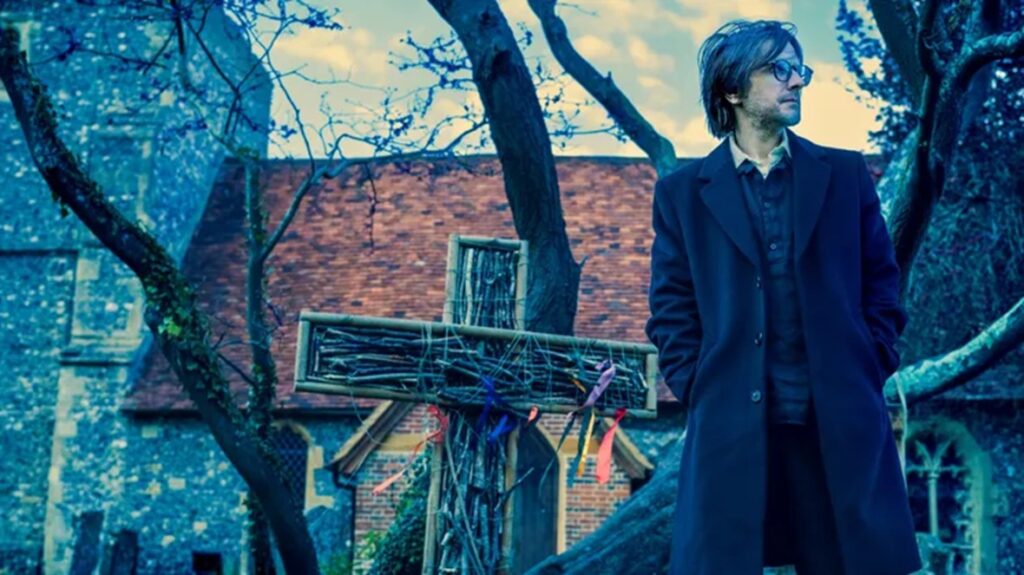
The greatest strength of „Requiem for a Village” is precisely the fact that Wilson does not try to impress through technique at every turn. He could do that almost whenever he wanted, but this time atmosphere, narrative, and the feeling of taking part in a story whose rules are not immediately revealed matter far more. The compositions feel like successive scenes from a film, while recurring bells, whispers, creaks, and unsettling noises create a shared language for this strange village. The music can be delicate and almost pastoral, only to suddenly veer toward a heavy riff, fractured electronics, or psychedelic unease. Most importantly, that variety never feels like a demonstration of versatility. Everything serves a specific world and atmosphere. Imperfections, too, stop being things that need to be hidden. Detuned textures, analog unpredictability, and parts played without virtuosic certainty give the material a character that no amount of additional studio polishing could have achieved. This is one of those Wilson albums where production precision gives way to curiosity – and that is exactly why it sounds so fresh.
Only on that foundation do the individual compositions truly begin to work. „Swirl in a Lark’s Eye” draws the listener into this world like the prologue to an old film, before the nearly eight-minute „Requiem for a Village” combines the jagged rhythm of drum and bass with progressive rock and a metallic edge. Beneath the apparent chaos lies precise dramatic structure, while the bass and drums give the whole piece a hypnotic, slightly deranged pulse. „The Same River Twice” brings string-laden melancholy, while „Now Departing” moves from seemingly light melodies into rhythmically fractured passages. The instrumental „Hiraeth” – whose title describes a particular kind of longing for home or for a place to which one can never truly return – offers a moment to breathe before „On Chapel Slope”, where delicacy gradually begins to resemble an unsettling ritual. „Murmuration” is especially beautiful, with Katherine Priddy’s ethereal contribution deepening the fragile, folk-like character of the composition. „A Basket of Bees” evokes the spirit of 1970s progressive rock, „Great Green Map” expands from an intimate story into a richly arranged whole, while the heavier „Wheel” provides some much-needed weight. By the time „The Old God Is Buried” appears at the end, it is difficult to speak of any conventional resolution. Wilson instead leaves us somewhere in the middle of this strange village with more questions than answers – which was probably exactly the point.
Not everything works with equal force, however. My biggest reservation paradoxically concerns one of the album’s foundations – just how strongly conceptual it is. „Requiem for a Village” works best as a complete experience, which means some of its shorter fragments lose quite a lot when removed from context. „Swirl in a Lark’s Eye” and „Cursus Fingerprint” are excellent at building atmosphere, but they are difficult to treat as compositions one is likely to revisit often on their own. At times, Wilson also seems more focused on constructing a strange sonic landscape than on creating a melody that will remain with the listener. I occasionally miss an emotional impact comparable to „Rock Bottom” or „Time Is Running Out” from „The Harmony Codex”. The rough textures and detuned elements have their purpose, although not all of them deepen the listening experience to the same degree. Tennant’s narration fits the atmosphere beautifully, but it further emphasizes the album’s character as a self-contained audio drama that demands concentration. I do not regard that as a serious flaw – more as the price of committing so fully to the chosen form. It is enough, however, to prevent me from placing this album alongside the absolute peaks of Wilson’s solo work.
„Requiem for a Village” is a very good album and further proof that Steven Wilson has no intention of turning his discography into a catalog of proven solutions. An artist who spent years setting standards for almost laboratory-level production perfection is now consciously looking for beauty in imperfection. Folk innocence transforms into psychedelic unease, analog textures collide with electronics, and delicate melodies can give way to heavy riffs without warning. Not every idea hits with equal force, but I find the direction extremely interesting. „The Harmony Codex” still feels like a more complete and emotionally powerful work to me, but the new album undeniably has its own identity, cohesion, and courage. More importantly, after all these years Wilson still sounds like an artist hungry for new experiences rather than someone simply managing his own legacy. I do not know whether I would want to live in the village he has imagined. I do know that I will want to return to its musical world. Because good music does not end with the final note – sometimes that is when it truly begins to work on your mind.