
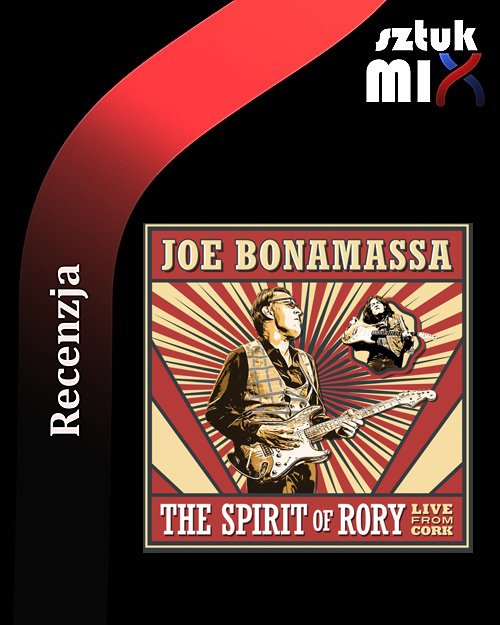
Some concert tributes smell like a museum piece from the moment they are announced: the classics played correctly, a few heartfelt words, and an audience that knows exactly when to applaud. With „The Spirit of Rory: Live From Cork”, the risk was even greater, because Joe Bonamassa had chosen to step onto almost sacred ground. Rory Gallagher was not merely an outstanding blues-rock guitarist, but one of those musicians whose legend was forged largely onstage. „Live! In Europe”, and above all „Irish Tour ’74..”, rank among the genre’s essential live documents, and part of their power comes from the sense that everything could spin out of control at any moment. Bonamassa represents almost the opposite aesthetic: meticulously prepared, technically immaculate, and usually in command of every element of the performance. That makes the central question all the more interesting: can an artist associated with absolute control convincingly capture the spirit of a musician whose greatest ally was the volatility of the stage? Released on June 19, 2026, through J&R Adventures, „The Spirit of Rory: Live From Cork” suggests that he can – as long as he does not try to become Rory Gallagher.
The project began with an invitation from Gallagher’s family and the idea of marking the thirtieth anniversary of his death in Cork. The legendary repertoire of „Irish Tour ’74..” served as the initial point of reference, but the concept quickly expanded into a much broader look at the Irishman’s solo career. What was originally planned as a single show ultimately became three sold-out nights at Live at the Marquee in July 2025. Bonamassa himself admitted that the prospect of performing these songs in Gallagher’s hometown genuinely terrified him. Cork was not simply another stop on the map; it was a place where Rory’s memory remains deeply woven into the local identity. Then there was the weight of „Irish Tour ’74..” itself – an album recorded in Cork, Dublin, and Belfast during The Troubles, when Gallagher was one of the few major artists who continued to perform regularly in violence-stricken Northern Ireland. Bonamassa was therefore not being asked to play through an ordinary catalog of songs, but to engage with material carrying the burden of history, place, and collective memory.
Most importantly, Bonamassa’s fascination with Gallagher was not invented for the sake of a one-off project. He discovered Rory’s records as a child through his father, and both „Live! In Europe” and „Irish Tour ’74..” helped shape the way he thought about the guitar. Years later, Bonamassa admitted that it was only while preparing for the Cork shows that he fully realized how deep that influence ran – perhaps deeper than he had previously understood, and comparable even to Eric Clapton’s impact on him. The traces of that admiration are visible from the very beginning of his career: his debut album, „A New Day Yesterday”, opened with a version of „Cradle Rock”. In 2011, Bonamassa also had the opportunity to play Gallagher’s famous 1961 Stratocaster, once again opening the set with that same song. In Cork, however, he had no interest in staging a costumed reenactment. He brought his own band – Jeremy Stacey, Aongus Ralston, Conor Brady, and Lachy Doley – and his own approach to dynamics. As a result, „The Spirit of Rory” grows out of a decades-long relationship with Gallagher’s music rather than the demands of a single tribute season.
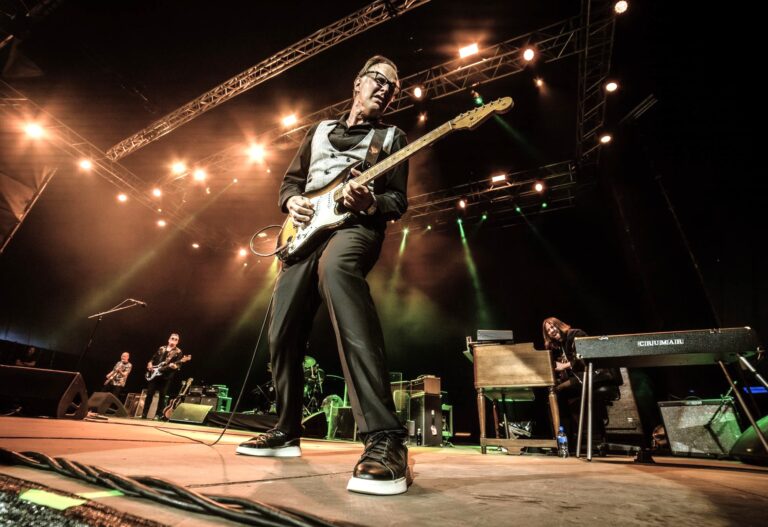
And for me, it is precisely this difference in character that gives the album its greatest value. Bonamassa does not possess Rory’s nervous, unpredictable wildness; his tone is bigger, smoother, and more contemporary, while the band plays with the precision of a finely tuned machine. Paradoxically, the record works best when it makes no attempt to disguise those differences. „Cradle Rock” opens the set with tremendous force while symbolically closing a loop in the American guitarist’s career, „Walk on Hot Coals” takes on the kind of weight associated with Bonamassa’s own live shows, and „Calling Card” reveals just how much jazz and rhythmic finesse was always hiding beneath the blues-rock surface of Gallagher’s music. The songs that leave more room for the players are even more compelling. „I Fall Apart” is expanded and gradually moves from an almost fragile opening toward a broad, emotional climax, while „A Million Miles Away”, featuring an excellent contribution from Jade MacRae, becomes the emotional center of the entire performance. This is not a new „Irish Tour ’74..” – and thankfully so. It is Gallagher’s music filtered through the sensibility of someone who learned an enormous amount from him, but who has long since developed a voice of his own.
There is also considerable pleasure in tracing the connections built into the setlist itself. „Cradle Rock”, „Tattoo’d Lady”, „Who’s That Coming”, and „A Million Miles Away” all come from 1973’s „Tattoo”, while „Walk on Hot Coals” opened „Blueprint”, released the same year. „Bad Penny” leads us to the heavier „Top Priority” from 1979, while „Calling Card” recalls Gallagher’s period of collaboration with Deep Purple’s Roger Glover. Bonamassa does not limit himself to Rory’s own compositions, either. „I Wonder Who” comes from the Muddy Waters repertoire, „Messin’ With the Kid” was written by Mel London and popularized by Junior Wells, „Bullfrog Blues” reaches back into the blues tradition associated with William Harris, „Treat Her Right” is closely identified with Roy Head, and „As the Crow Flies” comes from Tony Joe White. That last song carries particular significance: Bonamassa has recalled that it was one of the first pieces he ever learned on acoustic guitar, and in Cork he performed it on a 1930 National Triolian formerly owned by Gallagher and loaned by the Cork Public Museum. The album therefore also serves as a reminder that Rory himself was a remarkable interpreter of other people’s music. The best tribute does not have to be a faithful copy; sometimes it means simply carrying the same blues stories forward.
That does not mean everything lands with equal force. The album’s biggest limitation grows directly out of what has long been one of Bonamassa’s greatest strengths: his perfectionism. Gallagher live often sounded as though he and the band were discovering the song all over again in real time. He could speed up, tear a phrase apart, and push his guitar dangerously close to the edge of controlled chaos. Here, even the hottest moments remain firmly under control. Brady’s second guitar, Doley’s expansive keyboards, and Kevin Shirley’s modern production create a bigger and richer sonic picture, but they also strip some of the material of the lean, abrasive roughness of the originals. The difference is audible in the vocals as well – Bonamassa sings well, but he does not possess the distinctive crack or intensity of Gallagher’s voice. At times, the record also falls into the familiar live-album habit of extending songs beyond their natural weight. None of these are fatal flaws. They are simply reminders that Bonamassa cannot escape either his own musical nature or the legend of an artist whose live recordings have belonged to the canon for decades. That is why this album has a natural ceiling.
Ultimately, „The Spirit of Rory: Live From Cork” is far more compelling as a conversation between two guitar worlds than as an attempt to answer the question of whether Joe Bonamassa can play Rory Gallagher. Of course he cannot – because no one but Gallagher could ever do that. What Bonamassa can do is demonstrate why these songs still carry so much power half a century later, and how deeply they have become embedded in the language of modern blues rock. The finest moments – „A Million Miles Away”, „I Fall Apart”, „As the Crow Flies”, „Who’s That Coming”, and the closing „Back on My Stompin’ Ground” – do not sound like museum reconstructions, but like songs that are still very much alive. As a live album, this record does not add as much to Bonamassa’s discography as his strongest studio work, and placing it alongside „Irish Tour ’74..” would simply be unfair. It serves a different purpose. This is one guitarist thanking another, delivered in the one place where such a gesture carries more weight than anywhere else. And if, after the final notes fade, your first instinct is not to play another Bonamassa record but to immediately reach for the original Rory Gallagher recordings, it is hard to call that a failure. Perhaps that is exactly how you know the tribute has done its job.
Szymon Pęczalski