
This year’s Wrocław edition of Avant Art Festival stretched across an unusually long period: two full weekends and nearly an entire week in between, from September 3 to 13, 2026. Unfortunately, that is also the festival’s biggest drawback for anyone coming from outside Wrocław — there is simply too much happening to experience it all properly. As much as I would have loved to spend all eleven days in the capital of Lower Silesia, going to shows every night, that was hardly realistic. Choices had to be made. Even though this year’s edition was spread out over such a long period, once the organizers revealed the full schedule, I knew immediately which dates I would pick. September 11 and 12 worked out perfectly for me. Not only would I get to see some of my established favorites, but I would also have a chance to discover artists I had never encountered before — pretty much the ideal scenario for a compulsive concertgoer. As far as the sure bets were concerned, I knew I could count on excellent performances from The Necks and Zu. It is hardly a major spoiler to say right at the beginning that both delivered exactly that. Among the artists new to me, I was particularly curious about Saturday night at Protokultura, where Polish instrumental trio Extensa would be joined by Mikołaj Trzaska, as well as the highly improvisational Canadian group Earth Ball. Of course, those were far from the only notable acts appearing during Avant Art Wrocław’s second weekend, but for the rest, you will have to keep reading.
Friday, September 11 2026
Friday night began with a performance by Australian trio The Necks at Wrocławski Klub Formaty. Known for creating extremely long, slowly evolving compositions, they followed that approach here as well, performing two roughly fifty-minute pieces separated by a half-hour intermission. The first was, above all, an extraordinary showcase for drummer Tony Buck — not so much because of outright virtuosity, but because of his restraint and stamina. For almost the entire duration of the piece, he maintained essentially the same sonic pattern using a drumstick and a shaker that he rubbed against one of the drums. Bassist Lloyd Swanton and pianist Chris Abrahams had considerably more room for variation, engaging in something resembling an extended conversation. Swanton used the bow almost as eagerly as his fingers, while Abrahams’ melodic ideas shifted relatively frequently. During the final ten or fifteen minutes of this improvised piece, the atmosphere grew more dramatic, perhaps even slightly anxious, before the accumulated tension was finally released and the band broke for intermission. The second set was considerably more restrained and focused on Abrahams’ beautiful melodic playing. Swanton gave himself a little less freedom this time, abandoning the bow and limiting himself largely to articulating the rhythm on the strings. Buck, meanwhile, explored a much broader sonic range. As the composition developed, his sticks moved increasingly quickly across the drums and, above all, the cymbals, which gradually began to dominate the overall volume. Their counterpoint came from Abrahams, whose phrases became increasingly poignant, even moving. So much so that during the second half of the set I could hear people around me sniffing and see a few discreetly wiping away tears. I was hardly surprised — I was not far from reacting the same way myself. During the final ten minutes, Abrahams moved away from that emotional register toward more dynamic lower notes, while Buck was attacking his cymbals at machine-gun speed. Climaxes like this are characteristic of The Necks. Their painstakingly constructed pieces always seem to be heading somewhere. I have seen the Australians live several times and they have never disappointed me. Friday night at WKF was no exception.
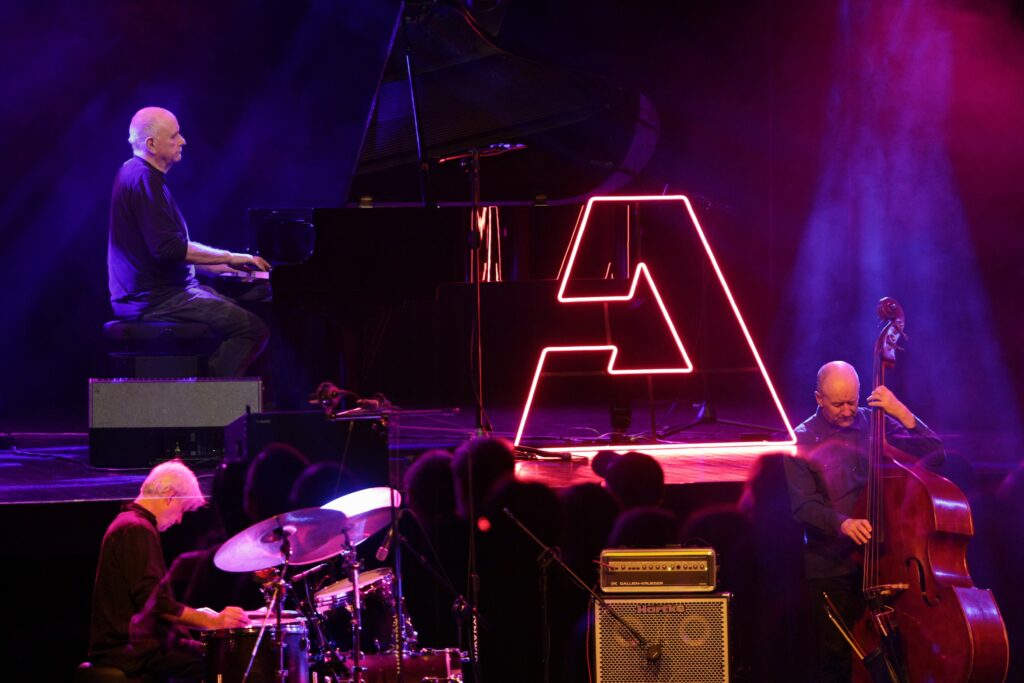
photo: Tobiasz Papuczys
After the show, it was time to relocate, as the rest of the evening’s performances were scheduled to take place at a food-and-culture complex called HUTA. It is not particularly far from Klub Formaty, but the distance combined with the length of The Necks’ performance meant I failed to catch even a fragment of Everything Is Psychedelic. Well — perhaps I will get another chance to see them at Unsound soon. Fortunately, I was in position by the time Indonesian duo Senyawa began their set. I had already seen them perform a couple of times, but this was my first opportunity to stand so close to the musicians. That also gave me a much better look at the Sustainable Sonic Engine, the handmade instrument built by Wukir Suryadi, who is responsible for the project’s instrumental side. Suryadi has attached a number of thick strings to a heavy piece of bamboo and plays them with picks, branches, a bow or drumsticks. The resulting hybrid of string and percussion instrument offers an enormous range of sounds, something he demonstrated throughout the evening. During the more atmospheric and ambient passages he treated the bamboo as a chordophone, while the more dynamic, rhythm-driven sections brought out its qualities as an idiophone. The vocal component was just as varied. Rully Shabara showed that he can deliver beautiful clean passages reminiscent of traditional folk singing, making excellent use of his remarkable intonation. The same was true of the more intense and nuanced sections, where he moved through screams, growls, shrieks and cries — a whole arsenal of wild yet carefully controlled vocal techniques. Even the set list was diverse. Senyawa opened with abbreviated versions of songs from their latest studio album, „Vajranala”, before moving into several tracks from „Menjadi”, released more than a decade ago. Midway through the set and again toward the end, they performed both parts of the title composition from my personal favorite, Alkisah. The sheer range of ideas packed into the duo’s performance made it highly engaging visually as well as sonically. Their forty-five-minute ritualistic show seemed to pass in an instant. Returning from the Indonesian jungle to ordinary reality afterward felt strangely unnatural.
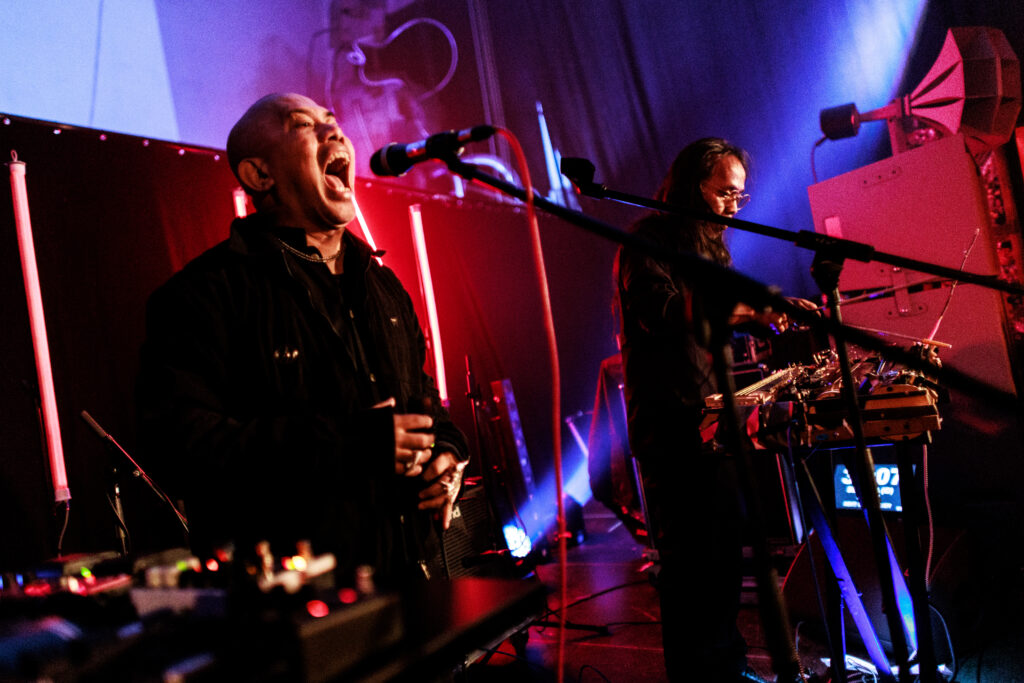
photo: Tobiasz Papuczys
Another major shift in atmosphere came courtesy of aya. She opened with an energetic performance of “I am the pipe I hit myself with,” the opening track from her latest album, „hexed!”, where aggressive rap collides with a deconstruction of British electronic music. For the next several minutes, however, she concentrated entirely on the latter. She put the microphone aside and turned her attention to the controls, experimenting with unreleased — at least for now — material that blended hardcore with UK bass. Later, she also returned to two tracks from her debut, „im hole”, although one of them, “Emley light us moor,” had been almost completely reworked into a fast, dance-oriented piece. Her original plan, apparently, had been to alternate album tracks with what she simply called “dance music,” but after some encouragement from the audience, she focused mostly on the former. As a result, the set was dominated by energetic vocal numbers, including the closing song — what she described as the only pop song in her repertoire — “off to the ESSO,” also her most popular track on streaming platforms. The standout moment, however, was the title track from „hexed!”: a superb ambient piece performed in almost complete darkness. It was a shame the whole thing lasted only thirty-five minutes, because the sheer variety of the performance left no room for boredom. As aya herself admitted, she had also prepared a new song and had even tested it in the room during soundcheck, but time constraints probably prevented her from performing it. The concert had started ten minutes late.
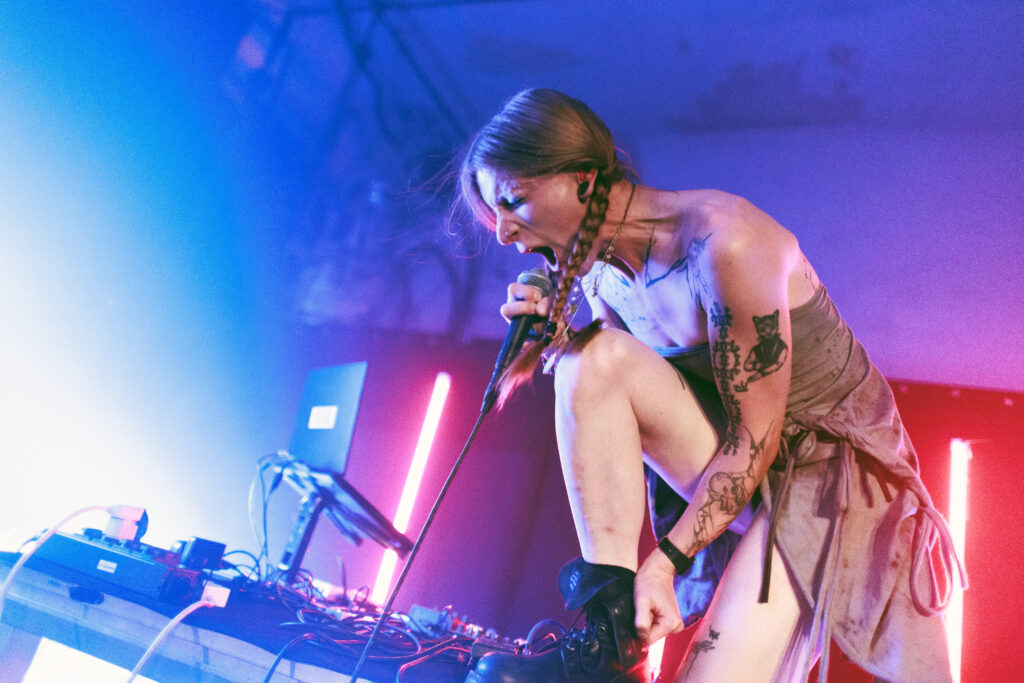
photo: Tobiasz Papuczys
Fortunately, Mariam Rezaei avoided any delays. Armed with two turntables and a pineapple Jarritos — which she proudly showed off on social media the following day — she gave the audience a genuine survey of extremes. Perhaps even a slightly overwhelming one. Rezaei is an excellent turntablist, and for most of her forty-five-minute set she built absorbing sound worlds that could be violent, unhinged or downright cacophonous — as in “Weirdo club musics” and “Going Straight (and fucking it up)” — or gentle and soothing in their repetition, as with “Vengabussed” and “Slipping”. There were moments, particularly early in the performance, when I found it difficult to fully lock into what she was doing or keep up with the logic behind some of her ideas. Maybe she simply needed a little time to build momentum. Or perhaps I was the one who needed time to adjust. Either way, fatigue from the trip to Wrocław and the previous performances was beginning to catch up with me, so I spent part of the set sitting down. But whenever I did start tuning into a particular sample or sequence, the sudden bursts of energy were exhilarating. By the second half of the performance, Rezaei and I seemed to be properly synchronized: not only did I leave the seats along the side of the room, I even started moving again. Despite my complaints, this was a very strong performance. I would happily see Mariam again, either solo or with her excellent new quartet, The Sleep of Reason Produces Monsters, whom I recently caught in Kraków.
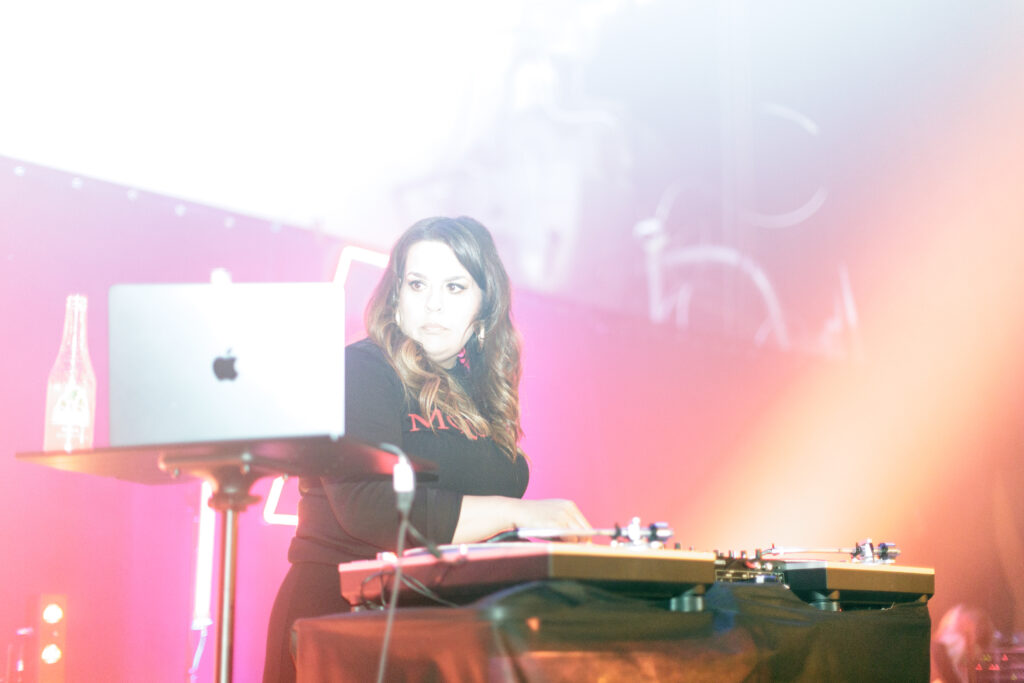
photo: Tobiasz Papuczys
The night was closed by its only Polish representative, Larmo. Behind the name is the noise project of Mirosław Matyasik, whom I once knew better — at least personally — as C.H. District. While electronic noise and the walls of sound that often come with it serve as Matyasik’s starting point, he does not abandon rhythm. Instead, it gives the music a danceable quality, which was very much the case during his set at HUTA. The first ten minutes served as an ambient-noise introduction, but drum-machine sounds gradually entered the picture, pushing the rhythm faster and faster toward industrial techno territory. Noise remained deeply embedded in the sound throughout: the samples were abrasive, the drums deliberately grainy, and Matyasik occasionally played with drastic shifts in volume, almost as though he were trying to sonically lash the audience. Emergency-siren sounds also made an appearance, presumably referencing the project’s name. In the Silesian dialect, “larmo” can mean not only an alarm, but also noise or a commotion. Most of those meanings seemed appropriate. Thankfully, nobody actually started a fight — not that there were many people left to do so. Only a small crowd remained by that point, which was understandable considering the set began after 2:00 a.m. Those who stayed, however, remained until the end. Their reward was several final minutes of harsh-noise wall before everyone politely dispersed to get some sleep ahead of another intense festival day.
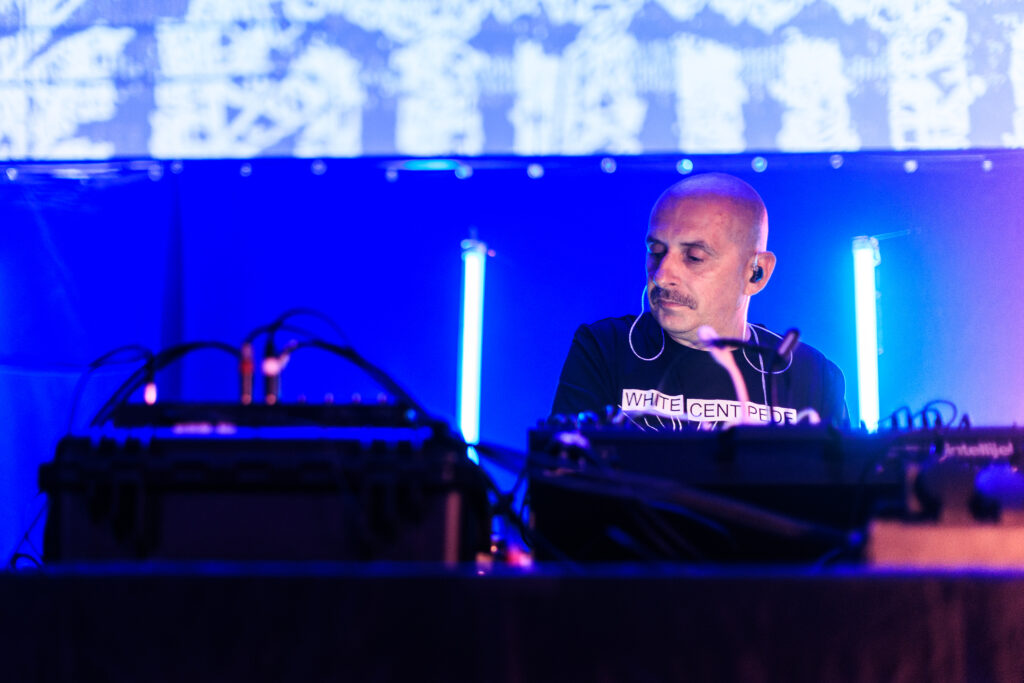
photo: Tobiasz Papuczys
Saturday, September 12 2026
As far as Avant Art was concerned, my Saturday did not begin with music. I was also curious about the exhibition “Los Pesados”, presented as part of the festival, so I arrived at Stajnia 66P shortly after opening time, when I did not expect many other visitors to be there. That was indeed the case, which gave me an opportunity to speak for a while with the creator of “The Heavy Ones”, as the Polish title translates. Chilean artist Manuela Morales Délano told me about the materials she had used to create the exhibits and the broader ideas behind the work. The main attraction consisted of structures and shoes made from bricks and scattered throughout the room, most commonly in the form of high heels or platform shoes. These were combined with ordinary objects from everyday life, including cutlery, bottles and beverage cans. In one piece, a Red Bull can effectively became a stiletto heel; in another, a Cisowianka bottle replaced the brick forming the main body of the shoe. Manuela explained that she always tries to incorporate a local element into her work, since the bricks themselves can appear superficially identical wherever you go. Interestingly, parts of the room’s layout also resembled high heels, with narrowing brick arches descending along the walls. The artist admitted, however, that this particular resemblance was purely accidental. So what was the idea behind it all? The concept of the exhibition has its roots in social protests and demonstrations. During the Mexican Revolution, Zapatistas threw shoes into industrial machinery, while in Hong Kong in 2019 small brick structures of this kind were used as road barricades. Watching over everything were the Heavy People — human-like figures constructed from clothing and, yes, more bricks. My impressions? Aside from the fact that the exhibition simply looked great, I also learned something about recent history. The exchange of knowledge worked both ways, since Manuela discovered that Iggor Cavalera, who was due to perform later that night, was the same person who had spent years in Sepultura. That was enough to convince her to go see his show. More on that later.
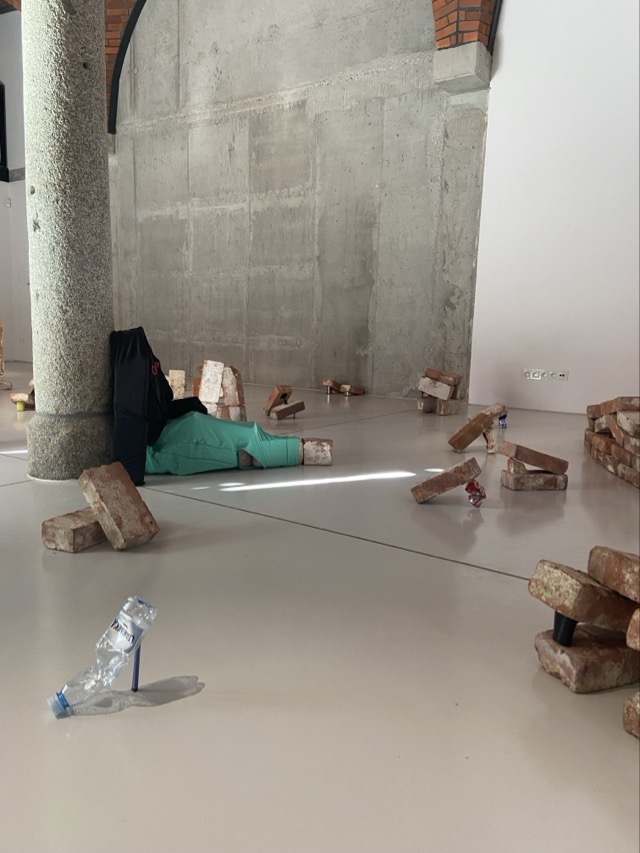
photo: Adrian Pokrzywka
Before the day’s main program began at Protokultura, another musical performance had been organized there in cooperation with Galeria Toy Piano. And this was no minor event: the central figure of the project was another genuine musical legend, Jean-Hervé Peron of German band Faust. Peron readily admitted from the outset that the main concept behind the collaboration, as well as the majority of the arranging, came from Paweł Romańczuk, leader of Małe Instrumenty. The names of those two bands actually provide a pretty good summary of what happened onstage that evening: ten pieces from Faust’s repertoire were performed by the assembled musicians on small, often toy-like instruments. As Jean also explained in his introduction, everything we were about to see and hear was intended to come from the pure, almost childlike joy of making sound. He had even learned a single Polish sentence for the occasion, which he delivered before the opening piece: “There is nothing serious about music.” Alongside the two leaders already mentioned, the project’s core lineup included Andrzej Załęski, who handled an impressive range of percussion instruments, and two musicians I had previously known mainly from Wrocław bands Kurws and Atol Atol Atol: guitarist Hubert Kostkiewicz and bassist Jakub Majchrzak. Both had far more work to do here than in their regular bands. Whenever Hubert picked up the miniature guitar, his playing remained recognizably his own, but he was also responsible for several different keyboards, rubber chickens, a cell phone and various other gadgets. Kuba, meanwhile, abandoned the bass in favor of organ, xylophone, PVC pipes and other stringed instruments including the pipa and lute. Mateusz Rybicki made guest appearances on a tiny saxophone in several pieces, while Weronika Anna Brzychczy supported Jean vocally, including on the playful “Giggy Smile”. Brzychczy also brought a strong theatrical element to the performance — a little too strong for my taste — frequently using melodramatic spoken delivery on “J’ai mal aux dents” and engaging in dialogues with the Faust musician during “Don’t Take Roots”. Interestingly, her parts were performed in Polish. On the one hand, those eighty minutes delivered an enormous amount of stimulation. On the other, there was too much chaos and not quite enough synchronization in the improvisation for my liking. These songs are several decades old, after all. Perhaps slightly more faithful interpretations would have resulted in less confusion onstage. Judging from the audience response and the comments I heard afterward, however, the performance was generally well received. And the musicians themselves were clearly having a wonderful time, so perhaps I should stop complaining. It is also worth mentioning that some of these compositions were being performed live for the first time in history, which added another layer of significance. Either way, I am glad I had the chance to witness this musical experiment.
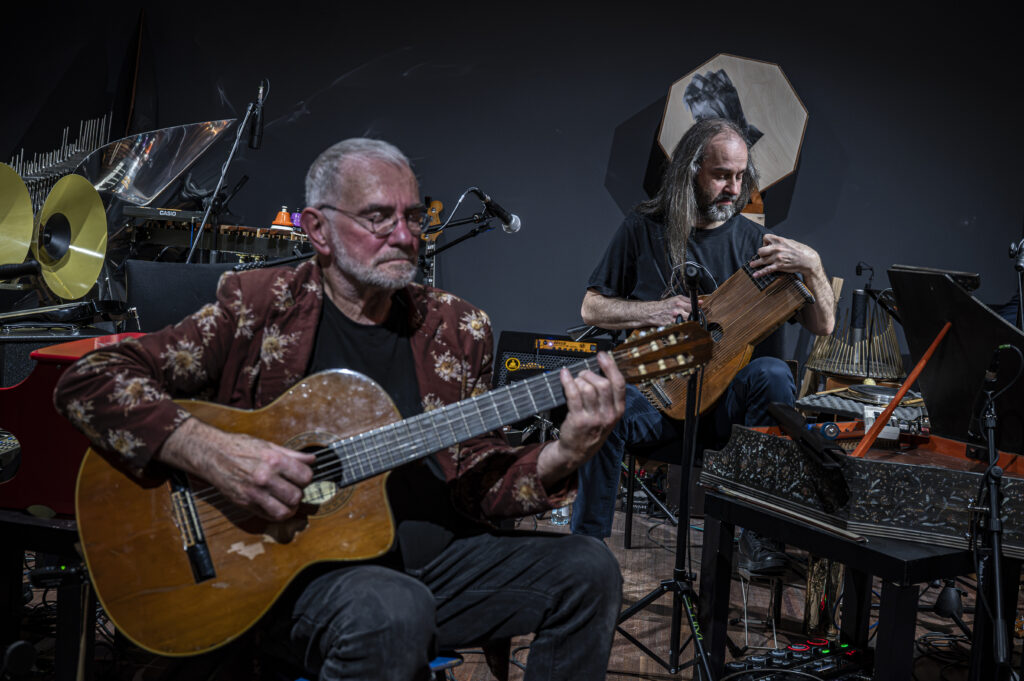
photo: Kazimierz Ździebło
For the next round of musical attractions, it was time to move to Protokultura, where no fewer than five more artists were scheduled to perform that evening. First up was another representative of Indonesia, this time appearing solo. Wukir Suryadi had performed with Senyawa the previous night, while on Saturday he entered into a musical conversation with Polish culture through a piece titled “Dialog Złotego z Opłatkiem”. The techniques he used on the Sustainable Sonic Engine were similar to those heard on Friday, although this time the entire set formed one continuous narrative rather than a selection of separate compositions. Individual elements had also been prepared specifically with the Polish audience in mind. Alongside the bow, branches and drumsticks he used on his instrument, Wukir introduced one particularly unusual material: a small bag of Polish grosz coins. During part of the performance, he dropped them between the strings of the bamboo structure, doing so with enough precision that their fall generated exactly the percussive sounds he wanted. In other words, he demonstrated quite literally that producing an excellent sound does not necessarily require a huge budget. The “opłatek” promised in the performance description — another local reference to Polish tradition — was represented by rice wafers, which Suryadi broke into a microphone against ambient textures he had previously created. Rully Shabara’s vocals were obviously absent this time, but that allowed the audience to concentrate on one specific sonic narrative, and I may have found it even more absorbing as a result. Especially because there were no breaks whatsoever: the music did not fall silent for a single moment.
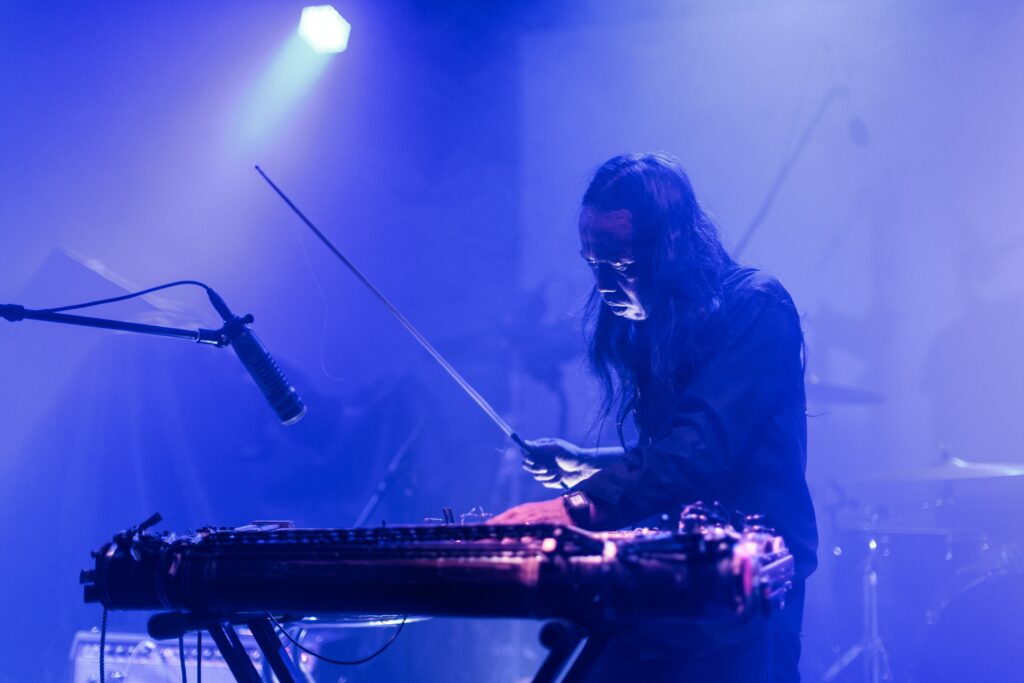
photo: Tobiasz Papuczys
Next came a collaboration between the relatively young Polish band Extensa — young in terms of how long the group has existed, certainly not the average age of its members — and one of Poland’s best-known and most widely admired saxophonists, Mikołaj Trzaska. When the show began, I initially wondered whether Trzaska had failed to make it to the venue, since only the instrumental trio appeared onstage. They attacked their instruments with such intensity that it almost seemed as though they were trying to compensate for the absence of their promised guest. That, however, simply exposed my own lack of preparation. It turned out Extensa always plays this way: heavy, dense and almost monolithic. Once I had adjusted to the sonic assault and taken a look around the audience, I spotted Mikołaj standing next to me. If anything, he seemed even more impressed than I was — a perfect visual definition of what it looks like when someone’s jaw drops. I do not know whether this had been the plan all along, but he did not join the others onstage until after the third piece. From there, he added an extra saxophone layer to another composition from last year’s “Echomora”. Once Trzaska had settled in and worked through a few minor monitoring problems with the sound engineer, the band moved backward through its catalog to material from its previous record, the self-titled debut. Apparently, those pieces were particularly well suited to the addition of another wind instrument. And speaking of that additional layer: while I generally prefer Mikołaj’s baritone saxophone playing in his other projects, the tenor worked better here — and was also the instrument he reached for more often that evening. Quite simply, it could be heard more clearly. The lower baritone parts frequently disappeared into Extensa’s dense wall of sound. As for the trio themselves, I fully intend to catch up on their records, although I have a feeling this kind of psychedelic intensity works even better live through a genuinely powerful sound system. That was certainly what all the musicians had at their disposal that night.
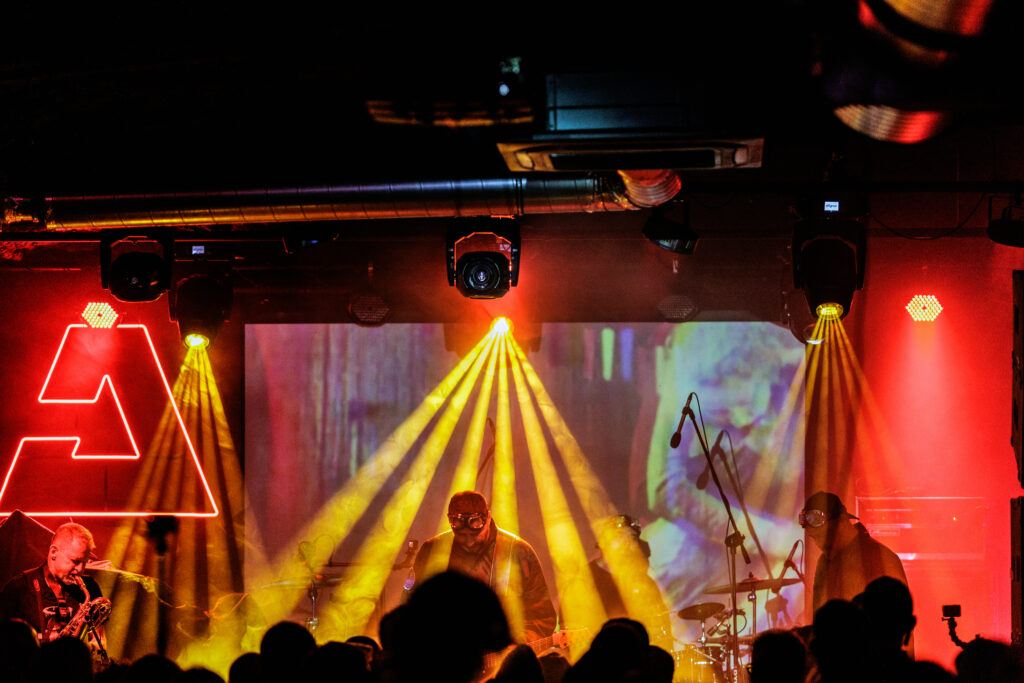
photo: Tobiasz Papuczys
Earth Ball benefited from that sound system as well. In their case, seeing and hearing the band live offered one additional advantage: everything they presented onstage formed a single improvisation lasting more than half an hour. Despite frequent repetition and the formation of drone-based structures, it remained remarkably varied. I had the feeling I had stumbled across a band designed almost specifically for me. On the one hand, they could pull the audience into a trance with looped phrases whose rhythmic pulse kept bodies moving. On the other, they were constantly introducing new elements and switching instruments. Vocals appeared at unexpected moments, only to reveal themselves as exactly the missing piece of a puzzle that the audience and musicians seemed to be discovering simultaneously. I think the drummer may have been the only member who consistently stayed in one role, effectively holding the entire structure together. Everyone else kept experimenting and filling in one another’s spaces. When the main saxophonist put down his instrument, one of the guitarists would blow into a plastic tube connected to his effects. When that guitarist returned to his strings, the other might pick up a trumpet or start singing. The bassist also contributed vocals while handling synthesizer and percussion. Then again, when it came to percussion, just about everybody in Earth Ball seemed to get involved at some point. It was an extremely ungrateful concert to write about. To describe everything that happened at Protokultura with any real accuracy, I would probably have needed to take notes continuously from beginning to end — and even then I doubt I would have captured it all. That was essentially my experience while watching it. More than once I caught myself becoming completely absorbed in one musician’s playing, only to realize that someone else alongside them was simultaneously building a parallel narrative that complemented it perfectly. I absolutely need to see Earth Ball again. For me, this was probably the best performance of this year’s Avant Art. Later, while resting on the stairs, I saw the subject of the next paragraph congratulating the Canadians on their excellent set. So perhaps I was not alone in that assessment.
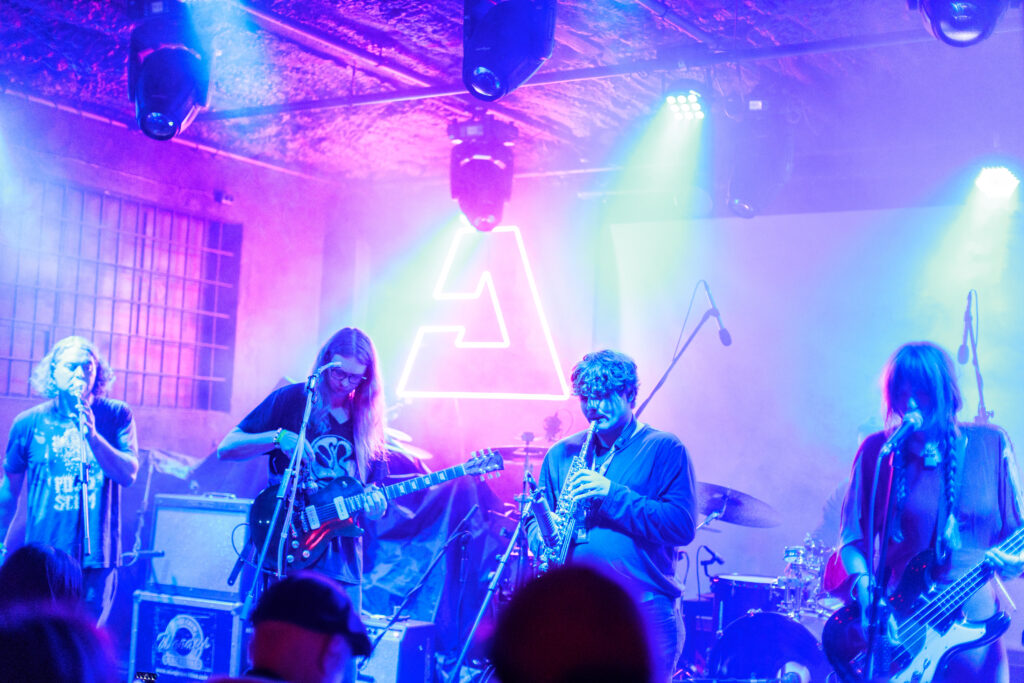
photo: Tobiasz Papuczys
The biggest name at a festival already devoted to fairly niche experimental music was undoubtedly Iggor Cavalera, co-founder of the legendary Sepultura. The famous drummer is also known for refusing to simply live off his past achievements in metal. He is equally interested in exploring the possibilities of modular synthesizers, drum machines and electronic music in general. That evening, he looked almost like a musical scientist: glasses on, intensely focused on the equipment spread out in front of him, moving from one device to another as he triggered and manipulated successive layers of sound. It felt as though we were watching an artist designing the music in real time. And perhaps that was exactly what was happening, which made the journey through Cavalera’s ideas extremely immersive. The set began in static fashion with tribal ambient, followed gradually by increasingly unsettling vocal samples. One surprisingly warm moment arrived around the halfway point, when softer synthesizer tones suddenly appeared and the progressive electronic textures gave the music some breathing room. Things turned colder again with the introduction of samples of Tibetan ritual bells, although the rhythmic layer still retained plenty of space. Toward the end of the electronic section, Iggor moved into EBM territory, and for a moment I felt as though I had somehow landed at Wrocław Industrial Festival. For the finale, however, the maestro finally sat behind the drum kit positioned at the back of the stage and began adding some genuine physical percussion over the drone layers he had programmed earlier. Cavalera clearly takes enormous pleasure in electronic instruments and all the associated machinery, but it was equally obvious that he still gets a tremendous kick out of the traditional, analog pleasure of beating the hell out of a drum kit. There was enough variety throughout the performance that its fifty-five minutes passed remarkably quickly.
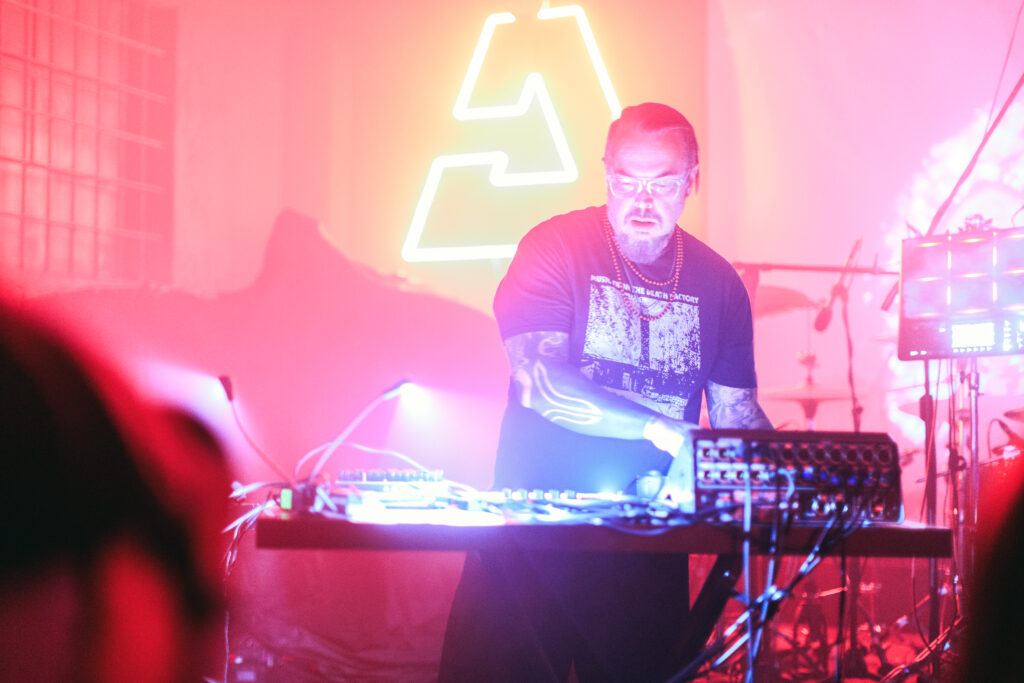
photo: Tobiasz Papuczys
Speaking of timing, however, this is where I have a complaint to file. The slot had originally been assigned to Zu, who were switched with Iggor in the schedule only on the day of the show. As I later realized, something had never quite added up in the original timetable anyway. Massimo Pupillo himself had told me in an interview that during their 2026 concerts the band intended to perform the entirety of their new eighty-minute album, “Ferrum Sidereum”. The changeover after Cavalera took half an hour, and Zu’s performance began exactly thirty minutes late. By that point I already knew I would unfortunately be unable to watch the entire set. I had booked my return trip to Kraków for what originally seemed like an extremely safe departure time, well after the scheduled end of the concerts. It is slightly difficult to believe that this level of organizational chaos can still happen in 2026. I had thought delays of this scale at Polish shows were largely a thing of the past. But let us concentrate on the positives. As I had already expected from the first performances of the evening at Protokultura, Zu sounded absolutely massive. That applied to every instrument. Massimo’s bass had exactly the weight it needed, Luca’s baritone saxophone sounded majestic, while the synthesizers he alternated with provided a somewhat lighter counterpoint. Paolo appeared to have the most demanding job behind the drums. There was virtually no room for him to catch his breath, since he had to maintain the rhythmic foundation even during the calmer stretches of this uninterrupted performance. Unfortunately, I will simply have to take other people’s word for the fact that they managed to sustain that level for the full hour and a half and perform the monumental “Ferrum Sidereum” in its entirety. Which is a shame. I would have loved to hear those epic compositions from the second half of the album. Next time, I will make sure to build festival delays into my travel plans.
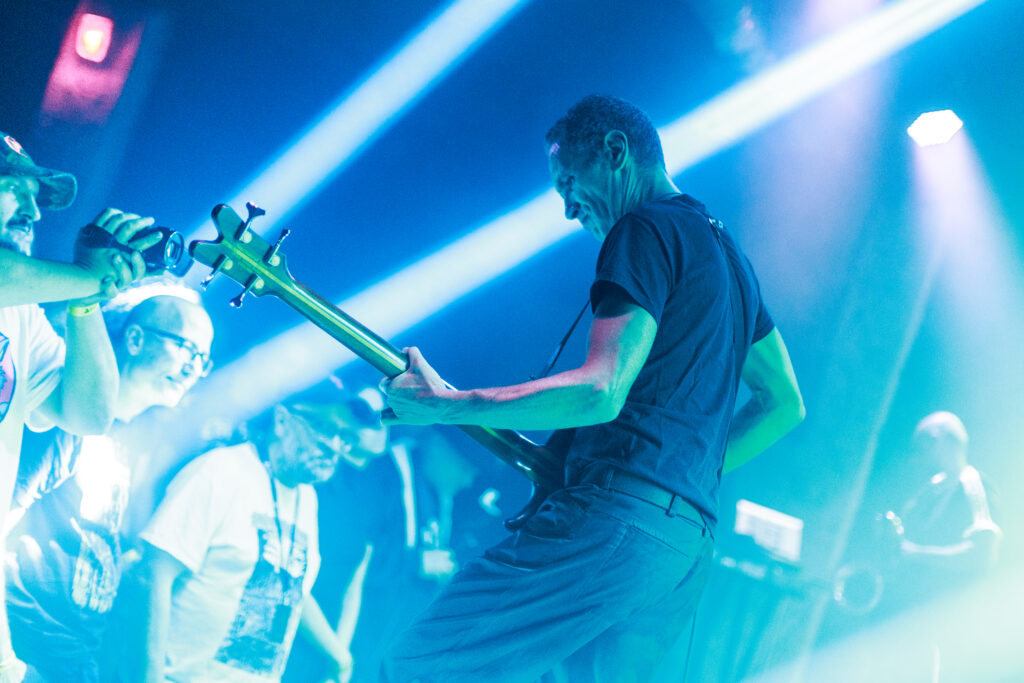
photo: Tobiasz Papuczys
Although this year’s Avant Art Wrocław did not end particularly happily for me, I am still glad I had another opportunity to attend what has by now become a truly iconic event — especially in the capital of Lower Silesia. The festival may have expanded into other cities, but Wrocław is where it all began. The city has no shortage of musical events, or cultural events in general, but when it comes to contemporary experimental music, Avant Art remains one of its brightest landmarks.