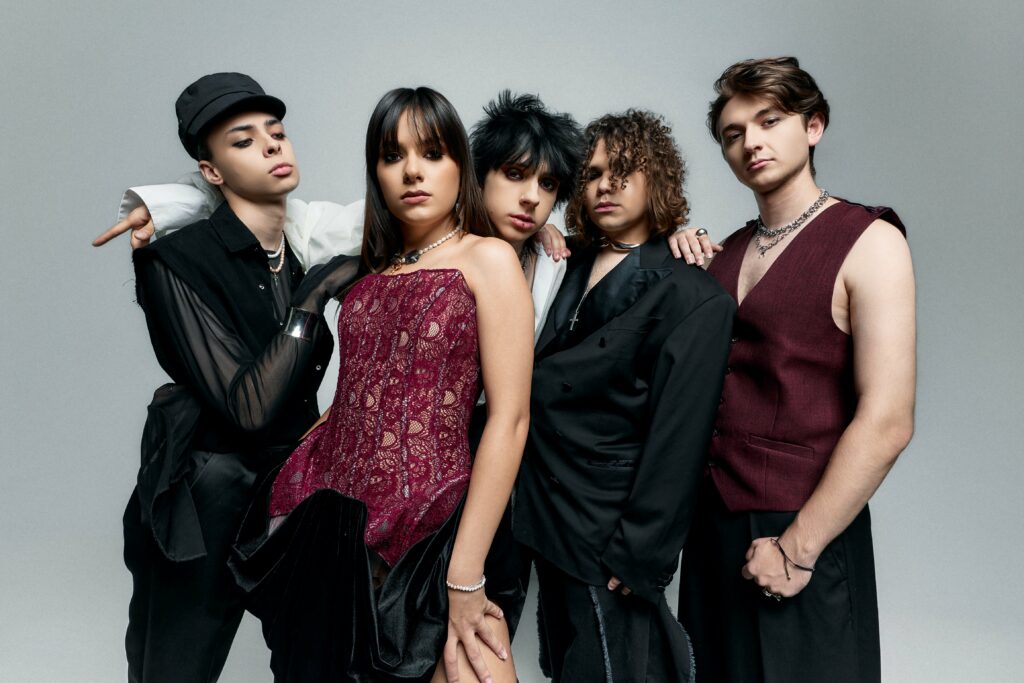
Alexandra Căpitănescu is not just the name of the band’s lead singer (although, as she admits, she isn’t particularly fond of being called a “star”), but also the name of the five-piece group. Joining her on stage are Bogdan Stoican (guitar), Matei Cohal (bass), Luca Sofron (drums) and Thomas Cîrcotă (keys). Their album Choke Me, which straddles nu metal, rock and alternative music, builds on the band’s musical identity following Alexandra’s Eurovision success. With the song of the same name, Romania achieved its best result in the history of the contest. In 20 minutes, we covered everything from the pressure of success and life after talent shows to internet archetypes.
Erik Zarbock: You’re only 23, yet you’ve already achieved something many musicians spend their entire lives working towards. Does that kind of success give you more confidence, or does it create more chaos in your head?
Alexandra Căpitănescu: Honestly, I’ve been waiting for this for 200 years because I’m a vampire. I’m not that young anymore! (laughs) Just kidding, of course. I’m grateful for everything that’s happened to me, but I didn’t achieve it on my own. Having a good team around you is incredibly important as an artist. If I didn’t have my band and all the people who support me, it might have taken me my entire life to get here. It’s difficult to do everything alone. I think the best thing you can do is surround yourself with people you’re happy with, do your things and enjoy the process. Because that’s the easiest thing to lose in a career. Sometimes we forget to enjoy performing on stage, writing songs and the whole process behind it. That’s normal, but we must remember why we’re here in the first place.
EZ: Does the band tell you straight up when you start getting carried away?
AC: Of course, but I’m the least diva-like person here. They (Thomas Cîrcotă and Luca Sofron) are the real divas!
EZ: Has fame changed the way you respond to criticism and hate?
AC: I don’t know if I can really answer that. Maybe my family and friends could tell you more. I don’t feel like I’ve changed. I’m still Alexandra and I still enjoy the same things I did before becoming popular. In Romanian, we have the word vedetă, which means “star”. I really dislike it because it tends to have negative connotations in the media. I wouldn’t want success to change who I am.
Luca Sofron: I think that even five years from now, if we were much further up in the industry, Alexandra would still be ordering soup at a restaurant just like she used to. She’d remain just as humble. I can’t imagine her becoming the kind of typical star people tend to picture.
AC: I have this motto: on stage, you’re a superstar, but off stage, you’re just a human being. So be nice to everyone.
EZ: Going back to the days when you weren’t yet a superstar on stage – The Voice. Looking back, are shows like that more of a career opportunity or a trap you have to escape afterwards?
AC: I think they can be both.
Bogdan Stoican: It depends on what you do with the opportunity you’re given.
AC: Exactly. In my case, The Voice was a huge step forward. I met a lot of people there and my coach from the show is now a friend of mine. We still talk and that relationship means a lot to me. My band got to know me through The Voice. I don’t know if they would have decided to play with me if I hadn’t been at least a little well-known back then.
EZ: What would you say to someone who’s just won a similar show and thinks the hardest part of their career is already behind them?
AC: That’s a really good question, because that’s exactly the illusion winners often fall into. During the competition, you feel enormous pressure. You’re thinking about the rivalry, the performances and winning itself. But once you win, a whole new set of challenges begins. You don’t always know what you want to sing or who you should work with. Maybe you’re lucky enough to already have a good team around you, but not everyone is in that position. I had to figure out for myself what I wanted to do and which direction I wanted to take. For a year or two, we experimented with different genres before finding our own path. And there’s nothing wrong with that. You just have to understand that winning doesn’t mean the difficult moments are over. You have to be ready for the next ones and face them with confidence.
EZ: Is confidence the solution to every problem then?
AC: “Fake it till you make it.” (laughs)
EZ: Then came Eurovision. How does someone so young cope with carrying the weight of their country’s best-ever result?
AC: The pressure is enormous, but our ambition and hunger to achieve what we want are even greater. Sometimes pressure can be a really powerful tool that you can channel into writing new music. Besides, it’s a huge honor. In many ways, it was even more difficult than The Voice because I was representing my country. I wasn’t there alone. We were representing Romania as a band and we felt responsible for what we were doing. We had to be very careful because even a small mistake could have serious consequences for our careers. At the same time, Eurovision is only the first step. You become an artist associated with the contest, but you can’t stop there. Now we’re working on our own music. “Choke Me” will always be an important song to me. It was the first one that allowed me to be that free and talk about the things that make me anxious. Now it’s time for the next chapter: concerts, new music and exploring new possibilities.
EZ: You mentioned the anxieties that have become part of your music. In “Hollow Heart”, a song from your new album “Choke Me”, you sing about the fear of being forgotten. Is that one of those fears that stays with an artist?
AC: I think an artist’s biggest fear is being forgotten. Everyone wants to be remembered for something, especially painters, singers and musicians. We want to create something that means something.
EZ: Marcus Aurelius, however, wrote that we’ll all eventually be forgotten.
AC: Marcus Aurelius definitely hasn’t been forgotten! I never met him personally, but I know who he is. We’re still listening to Michael Jackson, Freddie Mercury, Elvis Presley, Beethoven and Mozart. They haven’t been forgotten. They’re still with us through their legacy.
EZ: Speaking of how we’re remembered and how others perceive us, how do you accept compliments without losing your sense of perspective?
BS: I think this is particularly important for a frontman. The singer carries a much greater share of the pressure. It’s easier for the rest of us to deal with both compliments and less pleasant opinions.
AC: It’s just human nature. Of course, you’re happy when someone compliments you. I want to grow, and I know I’m not perfect.
Thomas Cîrcotă: She humbles herself. (laughs)
AC: This morning, a friend showed me a picture of Zara Larsson and said I had the same figure as her. I replied, “God, how can you compare me to Zara Larsson? She’s amazing!” We have to stay grounded, even when we receive compliments.
EZ: Since we’re talking about how others perceive you, your music and stage aesthetic suggest the “goth mommy” archetype, which has recently become a popular theme in internet memes. Thomas plays into it too, describing himself on Instagram as the “jester of the queen Alexandra Capitanescu”. How do you feel about that image?
AC: I wouldn’t say I’m a stereotypical goth mommy, but everyone can see me however they want. Someone might see me as a goth mommy, a queen or whatever else. I just see myself as me, and I’m comfortable with that. I’m not complaining. I have to admit that I don’t consider myself a goth person, but I understand where those associations come from. It’s our clothes, our style and the music itself.
LS: We just like dressing in black. It’s our style. Honestly, there isn’t that much goth in it.
AC: Besides, Luca, I think you’re the goth mommy here. (laughs)