
What the hell happened in Ireland? Just a decade ago, the country’s guitar scene was little more than an interesting curiosity. Today, it feels as though the Emerald Isle has somehow secured a monopoly on churning out one remarkable band after another from the broad post-punk universe. First came Fontaines D.C., The Murder Capital, and Gilla Band, almost tentatively, before new names began springing up like mushrooms after the rain. Before long, an entire new generation had arrived: Sprints, M(h)aol, Gurriers… and dozens more. By now, it is clear that the new wave of Irish post-punk was never just a passing trend. There is something deeper at work here – music rooted firmly in local identity, social frustration, and experiences shaped by a long history of struggle for independence. For younger listeners today, these bands have become a generational voice in much the same way U2 once was for their parents. The problem is that when the scene is this crowded with great bands, standing out becomes genuinely difficult. From the beginning, Gurriers never seemed interested in becoming just another name in the lineup. „Nobody’s Coming to Save You” sets out to answer whether they can separate themselves from the pack and start playing in a league of their own.
I have always been fascinated by just how much frustration – and social awareness – the contemporary Irish post-punk scene can contain. With Gurriers, the anxiety of living in a world defined by political, economic, and personal uncertainty practically pours out of the speakers. „Nobody’s Coming to Save You” is boiling over with emotion, and its ambiguous lyrics only add to the force of the record by leaving themselves open to multiple interpretations. The album plays almost like a chronicle of a generation that inherited a country mired in crisis and increasingly dubious promises. Astronomical rents feeding a housing crisis, a lack of prospects, and somewhere at the end of that road the possibility of spending adulthood under the same roof as parents and siblings – or, in some cases, homelessness. That brutal reality is enough to bring people to their knees, something you can hear in „Drones” and „Waiting for Fisher”. It is easy to lose your way („Nothing Happens Twice”) or escape into drugs and alcohol („Crybaby”). These are not abstract slogans, but realities faced by many young Irish people. Gurriers vocalist Dan Hoff observes that world with a reporter’s eye, but describes it in a language rich with metaphor and emotion. „Hope is not a whisper – it’s an axe you use to break down the door.” Hoff sings that line in the title track, making it clear that despite everything, there is still something worth fighting for.
On the other hand, Gurriers are not confined by the borders of their own island. Like many Irish artists, they do not shy away from global politics. Where Kneecap tend to go straight for the throat, Gurriers choose a more subtle approach. There are moments here that take aim at governments, media that numb the public into indifference, and celebrities who prefer to hide behind the comfort of neutrality. „Nobody’s Coming to Save You” is an album that insists indifference is also a choice – and one that comes with consequences.
„Party Line” opens with a pointed quote from Michael Parenti, the American political scientist, historian, and prominent voice of the US left: „Third World countries are not poor. Nobody goes to poor countries to make a profit.” Those words act as a key not only to the song itself, but to Gurriers’ broader political sensibility. Parenti wrote extensively about capitalism, imperialism, and the mechanisms of economic domination, arguing that many countries described as „poor” are in fact rich in natural resources that have long attracted the attention of global powers. Irish artists, Gurriers included, often view contemporary conflicts through the experiences inherited from their parents and grandparents. It is no coincidence that Ireland is sometimes described as „England’s first colony”. That is, of course, a historical simplification, but it captures something about the way many people on the island understand their own past: as a history of subjugation, exploitation, and a centuries-long struggle for self-determination. Opposition to imperialism or to the domination of weaker nations by stronger ones is therefore not merely a fashionable slogan within Irish culture. Like many Irish bands, Gurriers draw on that context to challenge the hypocrisy of political elites and side with those being oppressed. In that sense, it becomes easier to understand why Palestine – or, as in the case of „Party Line”, the war in Sudan – appears so frequently in the work of Irish artists.
Musically, „Nobody’s Coming to Save You” is a clear step forward from the debut. If there are moments when you think you can hear IDLES in the mix, you are not imagining things. One of the album’s producers is Mark Bowen, and his influence can be heard on several levels. You do not even have to look very far: parts of the opening track’s introduction sound as though they could have been lifted straight from IDLES’ recent work.
Loren Humphrey also worked behind the board, a producer whose credits include Geese’s excellent „Getting Killed” and Tame Impala’s somewhat less impressive „Deadbeat”. I get the sense that this particular combination of producers is precisely why the album refuses to lock itself into a single aesthetic while still retaining the post-noise-rock roots established on the debut. Around that core, Gurriers bring in dance-punk, shoegaze with its characteristic walls of sound, post-rock („Drones”!), and an industrial sense of propulsion that gives the record both momentum and variety. For most of its runtime, despite the bleak lyrical backbone, the material is practically begging for a serious mosh pit in front of the stage. Add a mix by John Congleton – a Michael Gira and Swans collaborator who also worked on my beloved „To Be Kind” – and you end up with a genuine melting pot of sounds. Remarkably, that apparent chaos works entirely in the album’s favor. Among the more surprising moments, „Shades” stands out for quieter passages that bring U2 to mind. „Pins”, meanwhile, one of the catchiest tracks on the record, feels as though Gurriers are knowingly winking at everyone whose knowledge of Irish bands begins and ends with Fontaines D.C.
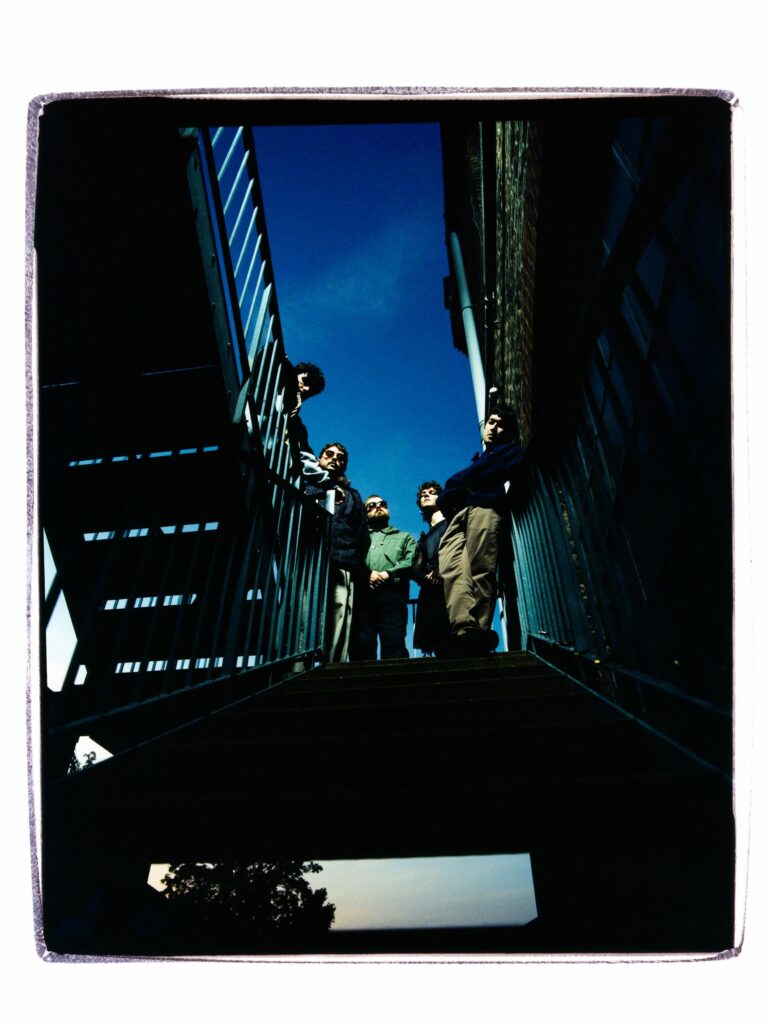
What matters most, however, is that the band has managed to create a dense, at times almost claustrophobic atmosphere. That is what binds all these musical influences together and allows the weight of the lyrics to hit even harder. No matter which direction Gurriers turn, a constant sense of unease hangs over the entire record, becoming one of its greatest strengths.
On their second album, Gurriers portray a world saturated with fear. Not the abstract kind manufactured by social media, but something tangible, justified, and painfully familiar in Poland as well. „Through all these years that somehow feel too short, the freaks have gone unpunished, we’ve been pulled out like weeds, and all those clowns are still sitting in their seats,” Dan Hoff sings in the album-closing „Crybaby”. It is a brutal statement, but it is difficult to imagine a better summary of the record. Gurriers offer no easy escape. They do not put on rose-colored glasses or try to sweeten reality. Instead, they magnify everything that hurts: social frustration, political disillusionment, and the sense that the world increasingly rewards the wrong people. But they also suggest that if we can find the strength, then we should still fight for something better.
Gurriers have proven that the success of their debut was no accident. „Nobody’s Coming to Save You” is a more mature, bolder, and simply better album than its predecessor. Is that enough to rise above the exceptionally fierce competition within Ireland’s post-punk scene? I am not entirely sure. One thing is certain: this record leaves a very strong impression and makes the band’s next move genuinely exciting to think about. If an album leaves you this hungry for more, it is hard to ask for a better recommendation.