
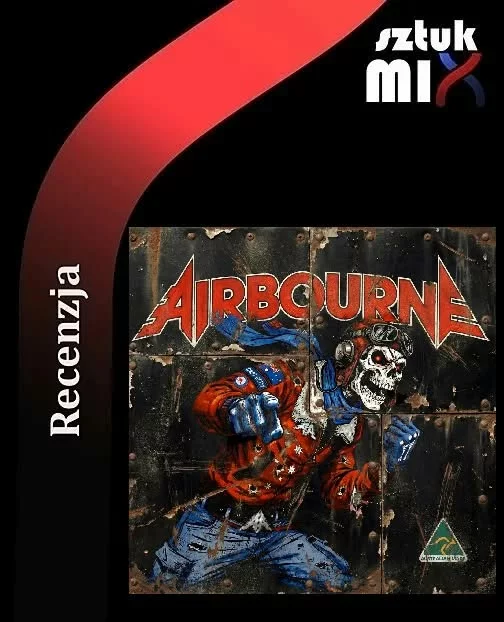
Airbourne are one of those bands that, after twenty years in the game, are somehow still expected to reinvent themselves. The Australians have always operated in a world where amplifiers have only one correct setting, a chorus should be shoutable after a single listen, and a guitar riff remains an argument strong enough to stand on its own. Seven years after „Boneshaker”, it was fair to wonder whether such a long break might bring any kind of revolution. The answer is no – and that is probably exactly the point. Their sixth album, simply titled „Airbourne”, feels like the clearest and most self-aware distillation yet of everything this band has always wanted to be. Its twelve songs make no attempt to run away from AC/DC, Rose Tattoo, Motörhead, or the arena hard rock of the 1980s. Instead, Airbourne take their influences, their live experience, and more than two decades of playing without paying much attention to trends, then turn every dial a little further to the right. The album was released on September 4, 2026, through Spinefarm Records.
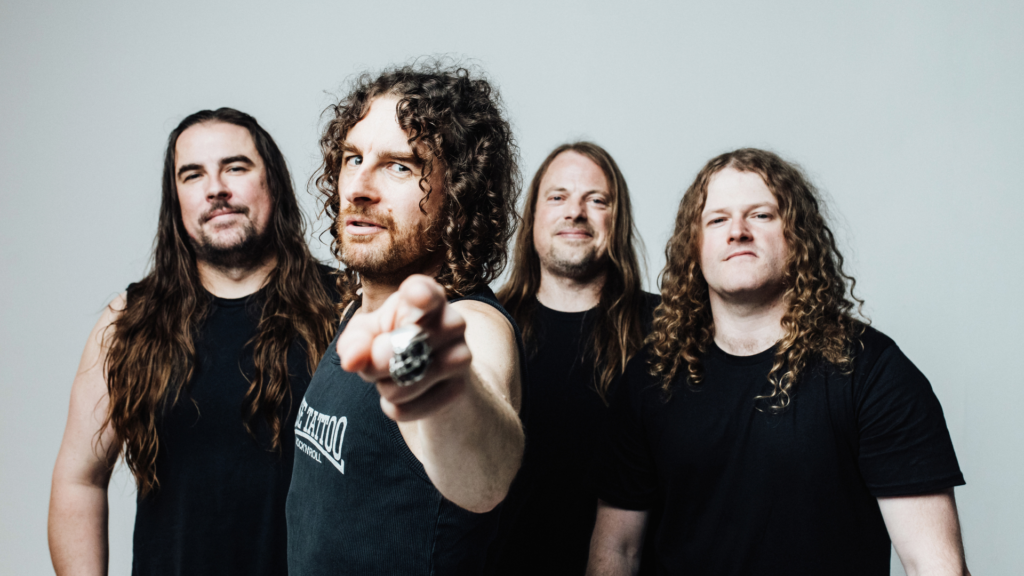
Seven years between studio albums is practically an era in Airbourne terms. „Boneshaker” arrived in 2019, only for its touring cycle to be brutally interrupted by the pandemic. Once the world opened up again, the band went straight back to the place where it has always felt most at home – the stage – and spent the following years making up for lost time. The current lineup also settled into place during that period. Brett Tyrrell, who replaced Matthew Harrison in 2022, joined Joel and Ryan O’Keeffe and bassist Justin Street, and it was this version of Airbourne that recorded the new material. The first clear sign of the band’s return came with „Gutsy”, which was already being performed live in 2025. For a while, the title even served as the working name for the entire record. In the end, the band chose its own name instead, which hardly feels accidental – from the beginning, the musicians stressed that they wanted to capture the purest possible essence of Airbourne.
That does not mean the album was made according to a simple „let’s walk into the studio and see what happens” philosophy. Before release, Joel O’Keeffe spoke of roughly fifty to sixty songs and ideas that were rewritten, reshaped, and filtered repeatedly. Part of the recording took place at Music Farm Studio near Byron Bay, using equipment deeply tied to the history of Australian rock – including a Neve console from Alberts Studios that had previously been used on recordings by AC/DC, Rose Tattoo, and The Angels. The band insisted on recording to tape, dealt with breakdowns, storms, and the local wildlife, then finished the sessions at Hothouse Studios in Melbourne, where Airbourne had recorded its first EP. Bryan Adams and Robert John „Mutt” Lange also became involved with „Here She Comes” and „Who Put the Rhythm in You?” – the latter, of course, forever associated with records such as „Back in Black” and „Hysteria”. Names like those could easily overwhelm a less confident band. Airbourne use them more like an extra turbocharger.
And you can hear it. „Gutsy” opens the album exactly the way an Airbourne song should: with a huge riff, a rhythm seemingly designed for live handclaps, and a chorus that feels familiar within a minute. „Alive After Death (Last Plane Out)” is more melodic and slightly darker, while „Here She Comes” immediately reveals the influence of Lange and Adams – there is more space in the arrangement, a smoother radio-ready finish, and a chorus built for tens of thousands of voices. Interestingly, its origin is more literal than you might expect: the starting point was a massive storm that hit Music Farm during the sessions, before the idea was reshaped into a typically Airbourne double entendre. „Kid in a Candy Store” and „Sky High” take the band back to its most shameless, pub-rocking form, while „Who Put the Rhythm in You?” adds a little swing and proves that Airbourne can change the way it walks without ever leaving the same street. In the second half, „Last Man Standing” and „Rock ’n’ Roll Ya” return to galloping simplicity, „Bogotá” brings a Van Halen-like bounce, and „Hells Got No Vacancy” plays like another anthem for a man too incorrigible even for hell. There is no revolution here, but for most of these nearly fifty minutes, one simply is not needed.
The real strength of the material, however, lies not in its energy alone, but in the way Airbourne looks backward without turning itself into a museum piece. „Alive After Death (Last Plane Out)” grows out of the belief that dead musicians remain alive for as long as somebody keeps listening to their records and saying their names. For Joel O’Keeffe, the central figure behind that idea was Lemmy, whose importance to Airbourne’s own history the Australians have acknowledged for years. The theme returns in the closing „Send Me to Rock ’n’ Roll Heaven”, which invokes, among others, Lemmy, Bon Scott, John Bonham, Malcolm Young, Eddie Van Halen, Little Richard, Doc Neeson, and Ozzy Osbourne. As a result, an album that begins with the word „Gutsy” ends with something close to a generational statement: this music was inherited from those who came before, and now it has to be kept alive. „Bogotá” has a great story behind it as well. Ryan O’Keeffe recalled that the idea appeared spontaneously when Joel picked up a Van Halen guitar lying around the studio and started playing, while the drummer simply joined in. A few days later, the song was finished, with the lyrics growing out of the band’s experiences in Colombia. Airbourne sounds most natural in moments like these – first comes the impulse and the noise, and everything else follows afterward.
What makes „Airbourne” so effective inevitably also defines its limitations. Anyone who has spent the past two decades accusing the Australians of being too deeply indebted to AC/DC is unlikely to change their mind after album number six. The opening of „Last Man Standing” almost automatically brings „For Those About to Rock (We Salute You)” to mind, several riffs sound as though they have existed in Australian hard rock forever, and the band’s lyrical universe still revolves mostly around women, rock ’n’ roll, the road, hell, and partying. „Christmas Bonus”, meanwhile, is such a shameless joke that some listeners will laugh while others may want to check whether they have somehow been transported back to 1987. What bothers me more than these deliberately worn-in clichés is that, after such a long break, I would have liked to hear a little more of the freshness found in „Who Put the Rhythm in You?” or „Bogotá”. When several of the more traditional songs appear back to back, the formula becomes exceptionally easy to read. Still, it is difficult to make that a serious complaint against a band that has never promised stylistic revolution. Especially since even the most predictable songs lack neither performance energy nor choruses that start taking on a life of their own after two listens.
Ultimately, „Airbourne” turns out to be exactly the album its title promises: not a new beginning, but the purest possible distillation of the Australians’ style. The band has no interest in proving it can write a progressive suite, embrace electronics, or create a mature concept album about mortality. It would rather turn up the amps, find a riff that survives being played at full volume, and see how many heads start nodding within seconds. This time, however, Airbourne does it with greater production care than on „Boneshaker”, with Joel O’Keeffe sounding especially strong behind the mic, and with several moments showing that even within its very narrow musical language, the band can still shift the emphasis. „Here She Comes”, „Who Put the Rhythm in You?”, „Bogotá”, and the excellent closing „Send Me to Rock ’n’ Roll Heaven” rank among the strongest moments here. This is not the album that will convince people who have spent years waiting for Airbourne to stop sounding like Airbourne. For everyone else, it is very solid proof that rock ’n’ roll does not always have to discover new territory. Sometimes it is enough for it to keep making exactly the right amount of noise.
Szymon Pęczalski