
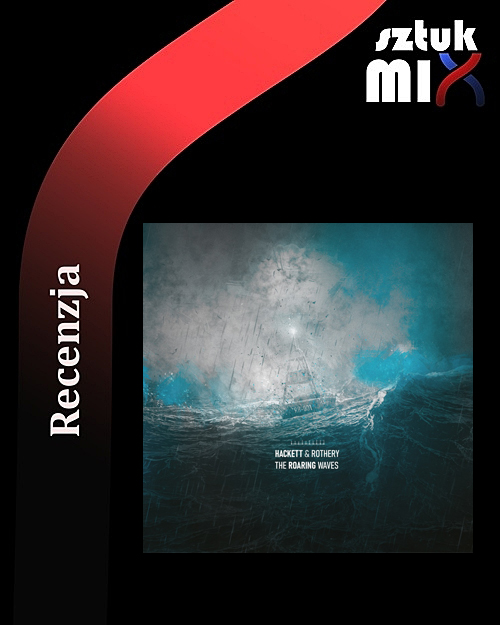
Steve Hackett and Steve Rothery are the kind of guitarists you can recognise within just a few notes, which meant that a collaborative album between them carried a certain degree of risk from the outset. Bringing together a musician who helped shape the classic Genesis sound with someone who has spent decades defining the musical identity of Marillion could easily have resulted in an elegant showcase for two illustrious names, or a record on which the listener simply waits for the next spectacular solo. „The Roaring Waves”, however, proves considerably more interesting than that. Across seven compositions and roughly forty-five minutes of music, there is little interest in establishing which of the two Steves can play faster, more impressively or more „progressively”. Instead, this feels like a conversation between two musicians with several decades of their own history behind them, yet who still know how to leave one another enough room to breathe. The sea provides the album’s central motif – a space of memory, menace, travel and mystery. The real question, then, is not „how much Genesis is there, and how much Marillion?”, but whether two such distinctive musical personalities can create a third language that belongs equally to them both.
The history behind this meeting stretches much further back than the album itself. Rothery has never hidden the fact that, as a teenager, he absorbed Genesis voraciously, while developing his own playing somewhere between Steve Hackett, Camel’s Andy Latimer and David Gilmour. Hackett, meanwhile, remains one of the architects of Genesis’ guitar language during the first half of the 1970s, and after leaving the band built an imposing solo catalogue while regularly revisiting his former group’s repertoire. Rothery took a different path: since 1979 he has been one of Marillion’s central figures, guiding the band from the Fish era and „Misplaced Childhood” through to the far more contemporary, atmospheric sound of the Steve Hogarth years. Their paths had already crossed in the 1980s, but a genuine musical friendship developed later. Rothery played on „The Lamia” for 2012’s „Genesis Revisited II”, while Hackett appeared two years later on „Morpheus” and „Old Man of the Sea” from Rothery’s solo album „The Ghosts of Pripyat”. By then, it had become clear that their styles did not need to compete with one another – quite the opposite, in fact: they could complement each other remarkably well.
The idea of making a fully-fledged album together emerged sometime around the middle of the previous decade, with the first substantial writing session taking place in October 2016. The project then developed intermittently, as both musicians had their own bands, tours and subsequent releases to contend with. They met at Marillion’s Racket Club and in home studios, building the material primarily from jams, drum loops and spontaneous responses to each other’s ideas. Four of the seven principal themes grew out of those earliest sessions, while the remaining pieces developed with the involvement of Riccardo Romano, the keyboardist and bassist known from the Steve Rothery Band. The maritime concept, meanwhile, crystallised after the two couples took a trip together to Whitby – the place where Rothery grew up and where the winter roar of the waves had been part of everyday life. In the meantime, Hackett continued touring and recording further solo albums, while Rothery worked both with Marillion and with Tangerine Dream’s Thorsten Quaeschning on the Bioscope project. That latter experience proves particularly relevant here, as the ambient-electronic vocabulary of „Gentō” seeps quite naturally into parts of „The Roaring Waves”.
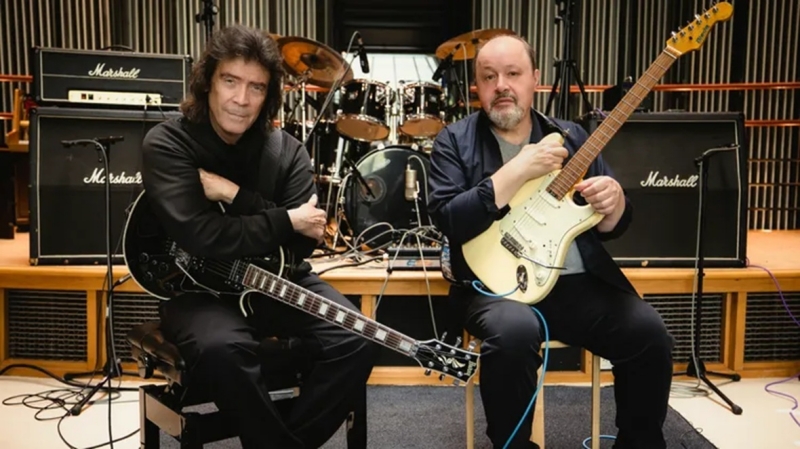
„The Roaring Waves” is a calmer record than a meeting between two guitar giants might suggest, though it is by no means lacking in tension. „The Storm” opens in an almost cinematic fashion and gradually gathers density until the two guitars begin answering one another in short phrases. „Sandsend” is its opposite: a soft, contemplative portrait of a place near Whitby, closer to a musical recollection of a walk than to conventional rock storytelling. Between those two compositions lies much of the album’s philosophy. Hackett more often introduces the unexpected – an unusual timbre, an acoustic or exotic texture, a more jagged phrase – while Rothery can bring order to the entire space with a single long, singing note and give it an emotional direction. Without consulting the sleeve notes, it is not always immediately obvious which of them is playing at any given moment, but paradoxically that is one of the album’s strengths. „The Roaring Waves” does not sound like a collection of separate Hackett and Rothery parts, but like the work of a band assembled specifically for this one record. Riccardo Romano deserves considerable credit for that, as do drummers Daniele Pomo and Leon Parr.
Much of the album’s pleasure comes from discovering how the stories behind individual compositions translate into specific musical choices. „Red Dragon” refers to one of the ships in the early fleet of the East India Company; hence the hurdy-gurdy in the introduction, Rothery’s heavier riffing and Hackett’s sitar guitar, which gives the piece an Eastern flavour. The title track, „The Roaring Waves”, is perhaps the most conventionally progressive moment on the album: an acoustic opening, symphonic spaciousness, a gradually unfolding solo and a guitar dialogue in the finale make it the section most readily associated with the musical worlds from which both men emerged, without directly imitating either Genesis or Marillion. More intriguing still is „K-129”, inspired by the Soviet submarine that sank in the North Pacific in 1968. Its sequenced pulse, sonar signals and increasingly intense guitar parts create something close to a ready-made soundtrack for a Cold War thriller; Rothery himself has described it as both his favourite track and the album’s most experimental piece. „The Black Sea”, meanwhile, turns towards darkness and suspension, evoking the depths of the Black Sea and the wrecks resting on its floor; Marillion fans may hear in it a distant emotional cousin of „Estonia”. Closing track „Pacific Coast Highway” unexpectedly lets the sunshine in. Hackett’s harmonica, the bluesy looseness, a livelier pulse and a wordless choir featuring members of both musicians’ families mean that, after spending almost the entire record amid turbulent waters, we suddenly find ourselves travelling along a sun-drenched coastline.
That consistency is „The Roaring Waves”’ greatest strength, but it also leads directly to its principal weakness. The album rarely allows itself to become genuinely wild. The guitars sound superb, the production is spacious and detailed, and the melodies have a habit of lingering in the memory, yet the middle section of the record occasionally blends into one long, elegant soundscape. With names such as Hackett and Rothery involved, one might reasonably have expected a few more moments in which they pushed each other beyond their respective comfort zones. Instead, they usually opt for taste, space and complete control. For similar reasons, „Pacific Coast Highway” may divide listeners: as a standalone composition, it is an excellent, life-affirming conclusion, but its bluesy, distinctly American looseness sits in sharp contrast to the cool melancholy of „K-129” and „The Black Sea”. On the other hand, that restraint appears to be the very point of the project. This is no „Guitar Wars 2026”, but an album made by musicians who no longer need to prove their technical ability to anyone. Their deliberate refusal to turn the record into a guitar duel should therefore be regarded less as a missed opportunity than as a conscious artistic decision.
Ultimately, „The Roaring Waves” says far more about the maturity of these two musicians than it does about their technical abilities. Hackett no longer needs to remind anyone of the role he played in developing the guitar vocabulary of progressive rock, while Rothery long ago ceased to be merely „the guitarist from the band compared to Genesis” and has become one of the most recognisable melodic players of recent decades. Their album together therefore makes no attempt to splice „Firth of Fifth” with „Kayleigh”. Instead, it draws upon the qualities that matter most in both of their styles – Hackett’s imagination, Rothery’s emotional tone and their shared love of imagery and melody – before filtering them through a fascination with the sea and cinematic music. Not every wave hits with equal force, and at times one wishes they had taken a little more risk, but as a forty-five-minute journey the album remains remarkably cohesive and possesses the kind of atmosphere that invites repeated returns. What is more, Rothery is already talking about plans for a follow-up. „The Roaring Waves” does not redraw the boundaries of progressive rock, but it makes a very convincing case that two musicians with instantly recognisable voices can meet somewhere in the middle without surrendering their own identities.
Szymon Pęczalski