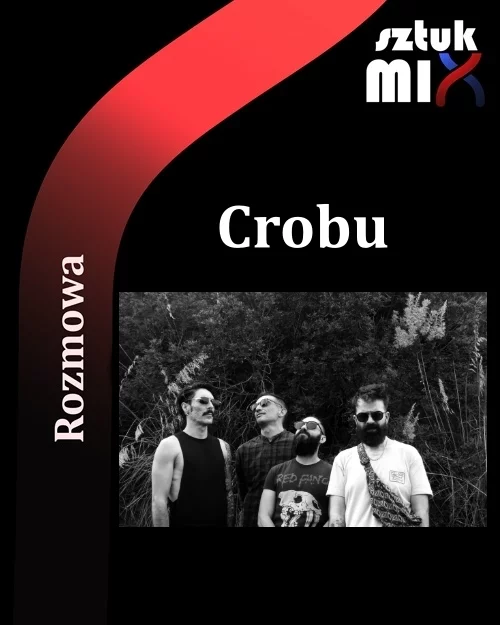
Interview with Sardinian stoner/doomers Crobu, who earlier this year released their groovy and intense album: “More Than This”. Why is Kyuss still relevant for modern stoner metal acts? How is it like to be an underground band from Sardinia? What non-musical inspirations fueled the musicians? How does the band get its groovy and thick sound? How can we support this underground act in the digital era? And what has the crow in common with the band? For those, and other questions you may find answers in the interview below.
Crobu is:
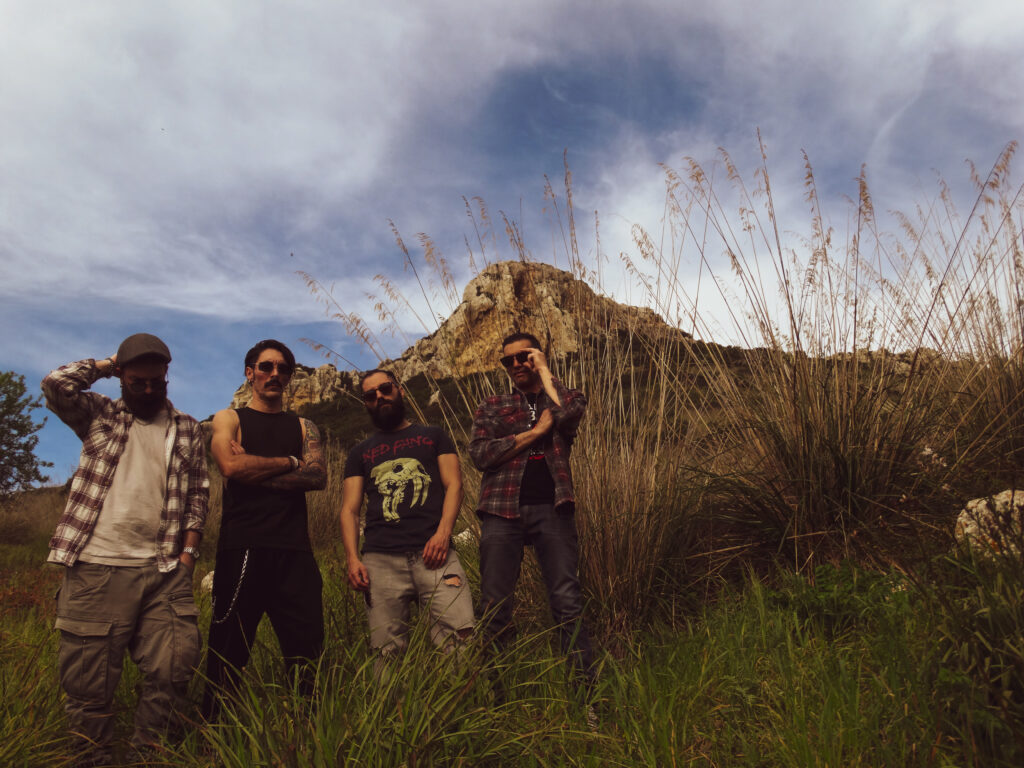
Lorenzo Meli – bass guitar,
Alessandro Brundu – drums,
Andrea Pisu – electric guitar,
Federico Paretta – vocals.
Marek Oleksy: Could you tell me more about the name of your band: “Crobu”? What does it mean?
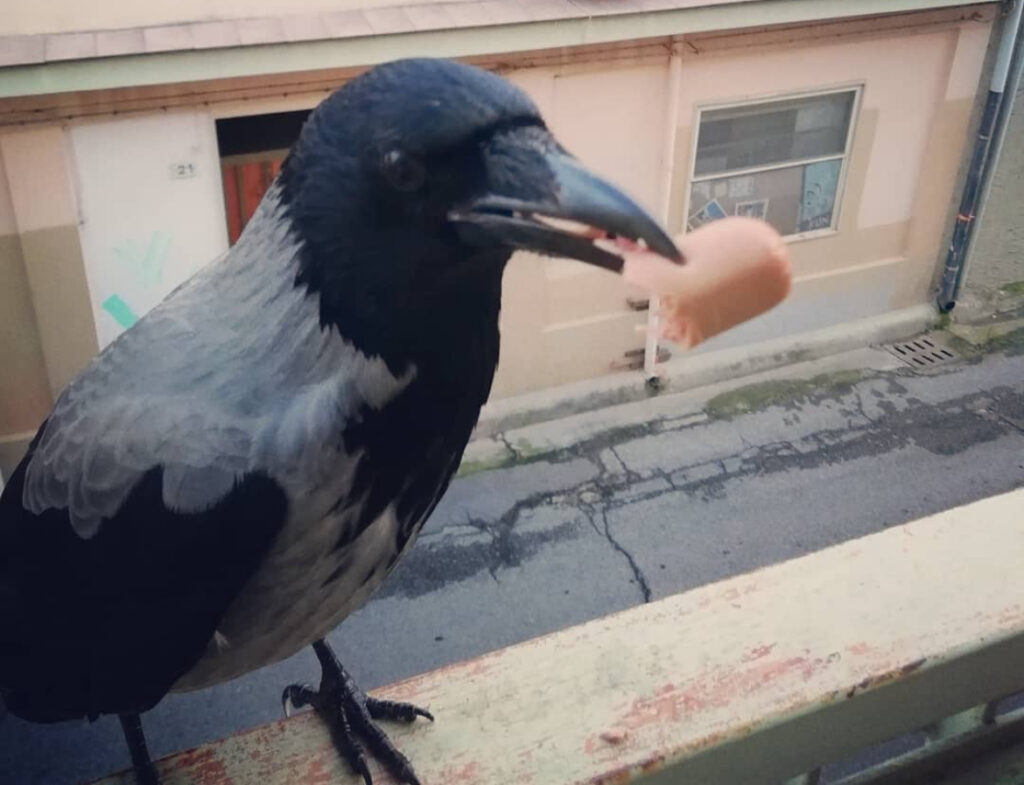
Andrea Pisu: “Crobu” means Crow in Sardinian (we’re from Sardinia; unlike other Italian dialects, Sardinian is actually an ancient language all on its own). Back when the band was still in its early stages, we used to rehearse in my attic. Over the months, a wild crow started visiting us. At first he was pretty shy, but little by little we became friends. It got to the point where he’d actually respond to my commands. He’d also come by every morning to wake me up, say hi, and often bring me little gifts. So yeah, naming the band “crow” in Sardinian felt pretty natural to me. I gotta confess, a few of our riffs were actually hummed to me by the crow himself.
MO: Sounds like an amazing story! Did the crow share any other secrets with you regarding music?
AP: Actually yes, but you’ll have to wait for the second album.
MO: No problem! Can you please tell me more about the band’s origin? How did you come together?
Federico Paretta: I happened to be in an area just outside the city where almost every garage is either a studio or a rehearsal space. I was walking around on the phone and heard some huge riffs coming out of the last room, and I thought to myself: I think I could sing on that! I snuck in and from that point on we changed lineups several times until we settled down and finally got the ball rolling. Andrea had been pushing the idea of the band for some time and we hit it off right away.
MO: How much time did you need to finally consolidate as a band and create an album?
FP: We truly bonded in the heat of the studio, where Andrea and I took charge of the album. It was exhausting, but it brought us together and it had to be done.
MO: What was the main reason to play in stoner/doom/sludge style? Was it an idea or it just came to be?
AP: It all started with a simple idea: grab a couple of amps, drive out into the middle of nowhere, and play for our friends, just like Kyuss used to do at their generator parties. Seeing that changed my life. No other genre captured that raw sense of total freedom and authenticity. Amps sitting in the sand, cranked all the way up, pure sound hitting you straight in the face with no ridiculous backing tracks or playback. That’s what we bring to our live shows. In a world of AI-generated music, bought followers, and pay-to-play, that’s exactly how we want to play: real.
MO: Sounds like an amazing idea! How many such “freedom gigs” have you guys performed?
AP: We’ve put together a bunch of them, and we still do it whenever we can. They’re secret, invite-only events with capped numbers, and between the forests and beaches, Sardinia has some insane spots for it.
MO: Sounds like a great adventure! In terms of music itself: Can you name your biggest influences?
AP: Definitely Kyuss, who I mentioned earlier, along with Down and Corrosion of Conformity. And, of course, Black Sabbath, without them, nothing heavier than hard rock would even exist, and they honestly deserve to be worshipped every single day.
MO: Sounds about right. I can hear the echoes of those influences in your music: sense of freedom and space from Kyuss, heavy and sandy melancholy of Down, hellish groove of CoC and riff worship of Black Sabbath. However, I also feel your music is not a copy-paste of those bands, but a mature sound with its own story and personality. Coming to this I have another question: how do you create your music? Is it during the band jam sessions or is it more structured, individual work connected altogether? Are you more into sudden bursts of inspiration, or every day work on music?
FP: We usually start with a riff or a rough riff structure, and the rest flows very naturally; I start sketching out vocal lines, transitions, solos, and various arrangements – all live. We always record our rehearsals and have high-quality archives; we could even make an album out of them – who knows?
MO: Your music focuses mainly on thick riffs, heavy groove and massive rhythm section. How do you achieve such a destructive sound? Or is it top secret information?
FP: No secret information, none of that. It’s just what we are and what we chase as Crobu.
MO: Returning to your inspirations: what are your biggest non-musical inspirations? Besides the crow of course!
FP: To me non-musical inspirations are philosophy, science and low-budget horror/splatter movies. Life inspires me a lot.
AP: Personally, my non-musical influences come straight from raw energy and ’90s pop culture. I’m huge on Jim Carrey’s over-the-top physical comedy, Transformers, and that whole era of ’90s animation that was way grittier and more aggressive than what you see today. Plus, Arnold Schwarzenegger has always been a massive influence on me, both for his legendary bodybuilding career and his action cinema run. It all feeds into that same raw, larger-than-life mindset I bring to the table.
Lorenzo Meli: I always loved the atmosphere of Old war movies and European comic books from the ’70s, so I think that is my biggest non-musical inspiration, and the one and only Ilona Staller of course.
Alessandro Brundu: Outside of music, I draw a lot of inspiration from movies, TV shows, video games, and anime. I love thrillers with mind-bending plot twists like “The Usual Suspects” and “Shutter Island”, along with sci-fi classics like “The Matrix”, “Blade Runner”, “Terminator”, and “Alien”. Series like “Black Mirror” and “Dark” hit that same mysterious, psychological vibe for me. I’m also heavily influenced by horror games like “Silent Hill”, plus the dark visuals and deep atmospheres of anime like “Berserk”, “Evangelion”, “Trigun”, “Akira”, and Studio Ghibli films.
MO: Regarding life as inspiration: From my point of view the lyrical themes found on “More Than This“ are describing life’s hardships and darker moments. Is it a form of katharsis, dealing with your inner struggles?
FP: It could be that – purification, ascension, the struggle for spiritual elevation; daily life is a bustling, frenetic workshop that rushes along, often leaving no room for awareness and understanding… there must be something more than this.
MO: You are a band from Sardinia, which is an island without any bridge or tunnel connection with continental Italy. How does the transportation difficulties impact you as a band? Have you ever played a gig outside Sardinia?
AB: As Crobu, we haven’t made it off the island yet, and we’re really looking forward to playing shows elsewhere. You’re right – living on an island doesn’t make things easy. I think the best solution is loading up a van and taking the ferry; it adds time and expense, but speaking from personal experience on past tours, it’s probably the method I prefer.
MO: Hopefully you will be able to reach Poland one day! Is there any stoner/doom scene in Sardinia? Or any other scene you are part of?
AP: If you’ve got any spots over there we could hit up for a gig, hit us up and we’ll definitely be there haha! The stoner scene in Sardinia is super active, and we’re on great terms with pretty much everyone.
MO: Could you please tell me more about the Sardinian stoner scene? Are you forming a kind of collective?
FP: As for us? We’re just having fun – nothing more, nothing less. That said, the Stoner scene in Sardinia is really strong and powerful, and I’m sure something is going to happen. In the meantime, we’ve got a new, bigger studio, and you’re all invited to come jam.
MO: What other bands from Sardinia can you recommend for your Polish fans?
FP: Well, as mentioned earlier, there are so many bands – and we wouldn’t want to leave any out – but Black Capricorn and Elepharmers certainly stand out, having set the scene’s stages ablaze for decades. Great bands guys.
MO: Awesome, thank you for the recommendation. Could you please tell your fans from Poland what is the best way to support your band in nowadays digital age?
FP: Supporting underground music isn’t just about streaming – Bandcamp, t-shirts, CDs, vinyl… digital word-of-mouth (playlists, posts, etc.)… the digital realm is democratic, allowing anyone to self-produce and make themselves heard, but ultimately, packing out clubs is what really fuels it.
MO: Question in the name of all gearheads and people passionate about music: could you please tell what guitar tuning and gear are you using to make your trademark “crow” sound?
AP: Ahahah of course! At its core, the tuning we use to get that deep, sludgy weight is Drop C (C-G-C-F-A-D). Dropping that bottom string gives us that massive low-end rumble while keeping power chords fast and heavy.
As for the rig to channel that trademark “crow” sound:
Guitar: Mostly a Gibson Flying V loaded with Dirty Fingers pickups. Throwing it onto the neck pickup is the secret sauce for that thicker, nastier, extra-swampy tone.
Amp: An Orange CR120 cranked all the way up to get that raw, pushed solid-state response.
Reverb/Ambience: A Boss Space Echo is almost always engaged to give the riffs that cavernous, echoing depth.
Pedalboard: A selection of dirt and modulation pedals thrown into the chain whenever we need to summon the full weight of the swamp.
MO: Awesome, thank you for the info! The last question: what is your greatest dream as a band?
FP and AP: Simple as that: to be remembered.