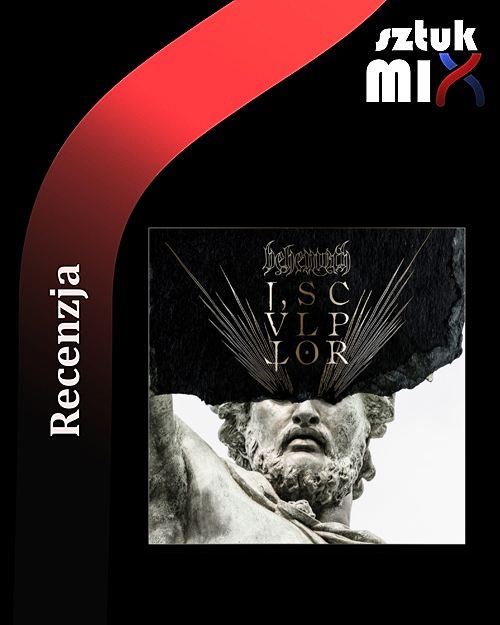
Behemoth have long existed in a reality where every new release is judged not only as a collection of songs, but as the next chapter in the band’s meticulously constructed mythology. „I, Scvlptor”, however, seems deliberately designed to sidestep those expectations. It is not a conventional follow-up to „The Shit ov God”, even though it runs for nearly forty minutes and forms a surprisingly cohesive whole. Instead of a proper studio album, we get eight recordings drawn from different points in Behemoth’s history: two entirely new songs, two older compositions rebuilt from the ground up, a track left behind during the previous album sessions, two covers, and a rougher mix of one of the new pieces. On paper, that sounds like a collection of material pulled from the vaults. In practice, „I, Scvlptor” is far more interesting because everything here is tied together by a single idea: reshaping the past without turning it into a museum piece. The sculpting of the title applies not only to the individual Nergal is singing about, but to the band itself – thirty-five years into its existence, Behemoth is still willing to pick up the chisel and alter its own form.
The past few years in the Behemoth camp have primarily been about further consolidating the position of a band that long ago outgrew the label of merely being Poland’s most successful extreme-metal export. When writing about „The Shit ov God”, I argued that Nergal and company had reached a point where they could operate entirely on their own terms, without worrying much about the expectations of either the market or the media. A year later, there is little reason to revise that assessment. 2022’s „Opvs Contra Natvram” expanded upon the monumental, highly stylized formula established by „The Satanist”, while „XXX Years ov Blasphemy” traced the band’s evolution from raw Pomeranian black metal to a massive international live machine. The tours that followed only reinforced the global scale of the operation. Interestingly, the bigger Behemoth became, the more often the band began looking back toward its own foundations. Not because it wanted to become the early-’90s Behemoth again, but because it wanted to find out which elements of that old language could still be useful today. „I, Scvlptor” may be the clearest expression of that mindset yet.
The defining release of this recent period, of course, remains 2025’s „The Shit ov God”. In my review at the time, what stood out most was its focus, its refusal to overstay its welcome, and its return to a rawer, more immediate attack that occasionally recalled Behemoth at the turn of the millennium. It was hardly a revolutionary record, but its self-awareness and consistency were precisely what made it so effective. „I, Scvlptor” grows directly out of those sessions, with „Begotten” serving as the clearest example – a song originally set aside because its new-wave and post-gothic undertones placed it outside the stylistic framework of the album. Even more intriguing, however, is the return to „Rise of the Blackstorm of Evil” from the band’s earliest days and „In Thy Pandemaeternum” from „Pandemonic Incantations”. The former grew out of an early fascination with Samael, Celtic Frost and Hellhammer; the latter, according to Nergal, had always contained strong riffs buried beneath the chaotic and imperfect sound of the original recording. Neither song has simply been dusted off. Both have been sculpted all over again using the tools Behemoth has at its disposal today.
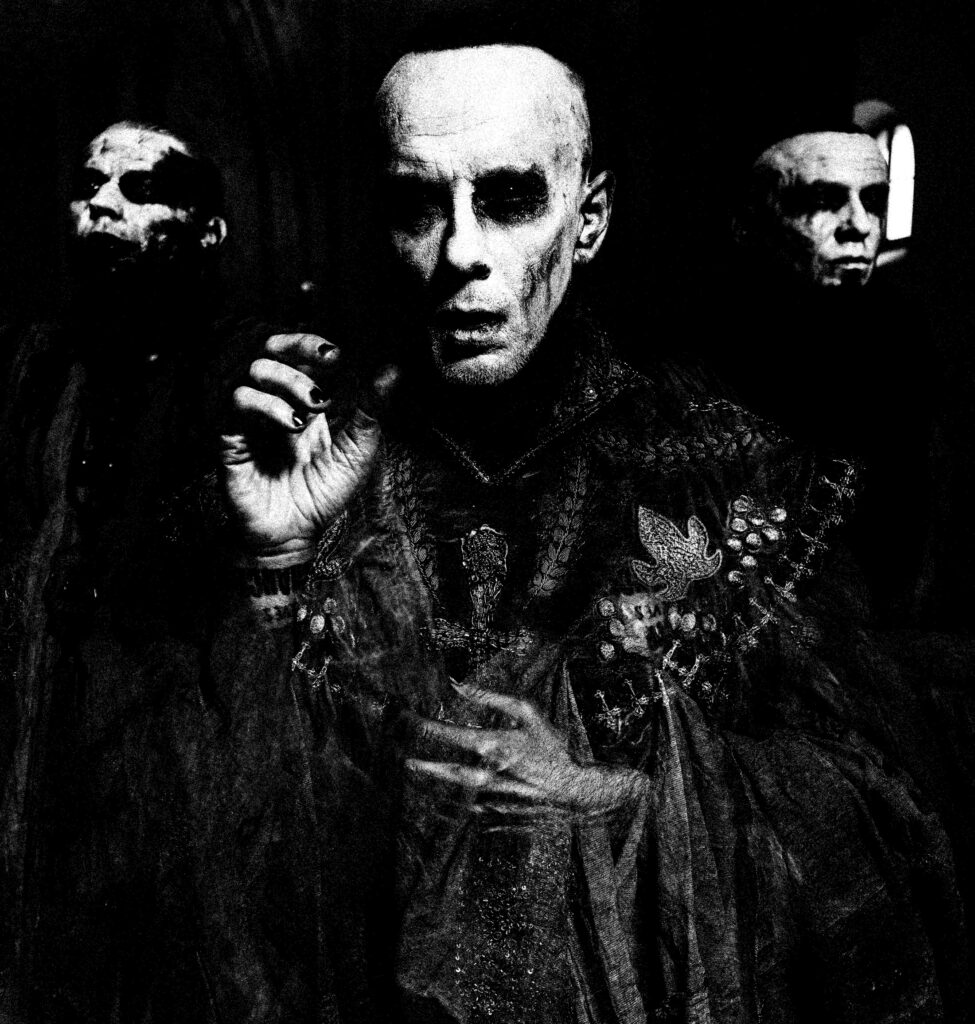
„I, Scvlptor” works best precisely as a bridge between different eras of the band’s history. The opening title track has everything one expects from modern Behemoth: monumental weight, a massive central riff, Orion’s bass given room to make a real impact, and Inferno’s drumming lending the song an almost physical force even at a slower tempo. At the same time, there is something less obvious about it than in the more predictable moments of its predecessor. „Lord ov the Horizons” is even more intriguing, opening in an almost gothic register, with Nergal delivering semi-clean vocals over a more spacious rock arrangement before the song gradually transforms into a far more militant second half. Lyrically, the two tracks complement each other just as effectively: „I, Scvlptor” deals with the endless process of shaping oneself despite the knowledge of one’s own mortality, while „Lord ov the Horizons” focuses on rejection and the necessity of rebuilding oneself from the ground up. If „The Shit ov God” was the sound of a band with nothing left to prove, here Behemoth uses that freedom to dig even deeper into its own DNA.
The greatest strength of this release lies in the way different eras of Behemoth begin to speak to one another. „Rise of the Blackstorm of Evil” retains the slow-crawling skeleton of the original, but its modern guitar arrangements and rhythm section make it sound almost like a new song written by musicians who remain acutely aware of where they came from in 1992. „In Thy Pandemaeternum” is even more striking. The new recording pulls details out of the composition that were buried in the dense mix of the original and reveals just how many elements of Behemoth’s later musical vocabulary were already present at the time. „Begotten”, meanwhile, provides a welcome stylistic detour: catchier and at times almost post-gothic, it shows that the band can still move slightly outside its usual frame without sacrificing its identity. The covers work well, too. Venom’s „In League With Satan”, recorded on seven-string guitars and featuring Dimmu Borgir’s Shagrath, gains an enormous amount of weight, while Bathory’s „The Return of Darkness and Evil” is presented as a live recording from Athens featuring Rotting Christ’s Sakis Tolis. The result is dirt, momentum and the unmistakable sense of a genuine tribute taking place in real time rather than another immaculately polished studio bonus track.
Whatever reservations one might have about „I, Scvlptor” stem primarily from the nature of the release itself. It would be unreasonable to expect the dramatic arc of a conventional album from a record that combines new songs, reconstructions, covers and a live track, so the second half inevitably begins to feel more like a carefully curated survey of different versions of Behemoth than a completely self-contained narrative. There is also room to question whether contemporary production always serves the older material equally well. „Rise of the Blackstorm of Evil” and „In Thy Pandemaeternum” gain power, clarity and technical precision, but in the process they move somewhat further away from the primitive unease and fog that defined the originals. That is not necessarily a flaw, however, but rather a consequence of the concept itself. Behemoth is not attempting to recreate those recordings note for note; it is revisiting them through the perspective and skill set of the band it has become. The least essential piece is the closing „Lord ov the Horizons (Studio Rough Mix)”. As a glimpse into the recording process, it has value, but the differences from the finished version are subtle enough that it works primarily as a bonus epilogue.
Ultimately, „I, Scvlptor” proves far better than its compilation-like construction might suggest. It should not be treated as Behemoth’s next grand statement or placed directly alongside „The Satanist”, „Evangelion” or even „The Shit ov God”. Its purpose lies elsewhere. This is a record about continuity – about how youthful obsessions with Samael, Celtic Frost, Hellhammer, Venom and Bathory can, decades later, intersect with the massive modern production, live experience and compositional discipline of the band Behemoth has become. A year ago, I wrote that Behemoth had reached a stage where its music could be driven primarily by experience and maturity. „I, Scvlptor” feels almost like a footnote to that thought, except that instead of another tightly constructed studio album, it gives us a chance to examine what that maturity was built from in the first place. Not every piece carries the same weight, and not everything lingers in the mind with equal force, but as a deliberately constructed bridge between past and present, the release works remarkably well. This is not a monument to a finished history. It is a workshop where the dust is still hanging in the air, the strike of the chisel can still be heard, and the sculpture is very clearly not yet complete.
Szymon Pęczalski