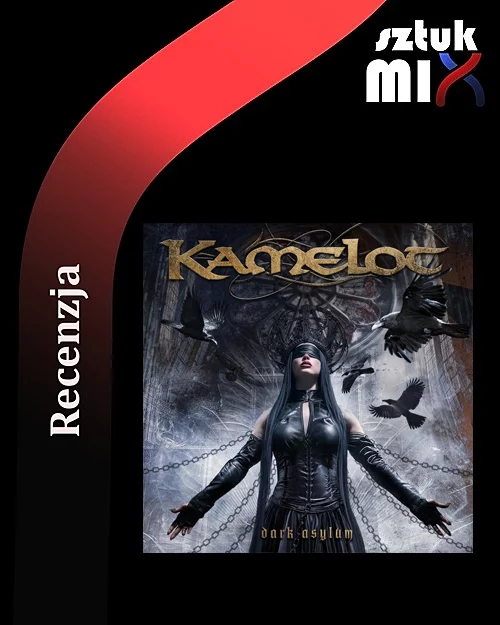
Some albums work best when treated as an enclosed space, allowing them to lead you from one room to another. „Dark Asylum” is precisely that kind of record. This time, Kamelot are not simply inviting the listener into another collection of symphonic metal compositions, but taking them inside RavenHill Asylum – a former cathedral transformed into a place where religious mysticism, experimentation, trauma and madness begin to bleed into one another. The brief „Sanctorium” already opens the door to this world, while each subsequent track increasingly undermines any certainty as to whether we are witnessing reality, memory, a vision or perhaps an attempt to escape one’s own mind. Released on 28 August 2026 through Napalm Records, „Dark Asylum” has therefore been constructed more like a musical spectacle than a conventional collection of songs. That does not mean, of course, that Kamelot have abandoned their characteristic language – monumental choruses, orchestration, heavy guitars and Tommy Karevik’s theatrical vocals remain the foundations of the whole thing. This time, however, what matters more than sheer grandeur is the steadily mounting sense of unease, along with the realisation that the titular asylum may be both a prison and a path towards salvation.
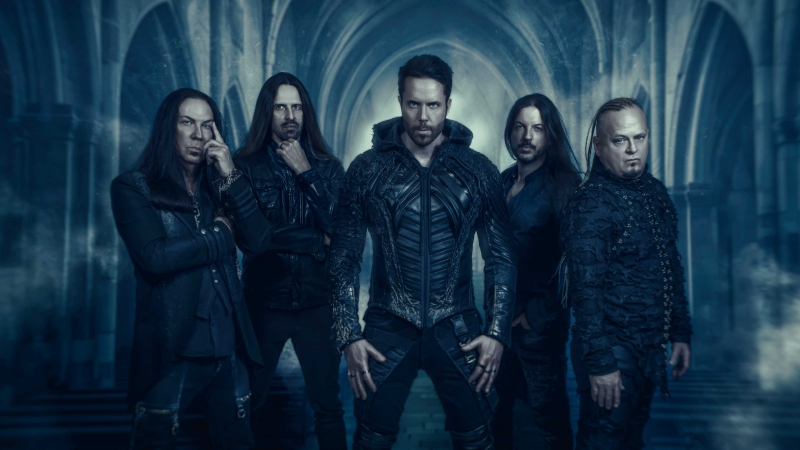
Recent years have primarily been a period of rebuilding momentum for Kamelot after an unusually long gap between releases. „The Shadow Theory” arrived in 2018, while its successor did not appear until five years later. Released in March 2023, „The Awakening” not only ended that silence but was also the first album of new material recorded with drummer Alex Landenburg. Its sales and chart positions also confirmed that the Karevik era had long since ceased to be regarded as a transitional phase – the album reached number two on the US Current Hard Music Albums chart, while in Germany it entered the Top 10 for the first time in the band’s history. Kamelot subsequently turned their attention back to touring. The „Awaken the World” tours covered Europe and North America, while in 2025 the band also returned to its beginnings, celebrating the thirtieth anniversary of debut album „Eternity” with „Ascension 1995–1998”, a release collecting their first three records. The current line-up – Karevik, Thomas Youngblood, Oliver Palotai, Sean Tibbetts and Landenburg – can therefore no longer be described as some „new incarnation” of the band. This is simply modern-day Kamelot.
„Dark Asylum” grows out of that period, but rather than continuing the more uplifting tone of „The Awakening”, it turns towards a darker and distinctly more gothic side of the band’s music. Thomas Youngblood has admitted that one of the aims was to recapture some of the atmosphere of „Ghost Opera” and „Silverthorn”, while introducing folk and new age elements reaching all the way back to the days of „Eternity”. This time, the creative process began not with individual songs, but with a world and a storyline. RavenHill is a former church converted into an asylum, and each composition opens another room while revealing a new psychological state of the central character. The brief „Sanctorium”, „Nocte Veritas” and closing „Sanctum Requiem” function almost like theatrical framing devices, between which recurring motifs of masks, fractured memory, truth, illusion and the search for refuge emerge. „Cassandra’s Disease” fits particularly well within this construction, referring to Cassandra – the figure condemned to know the truth while nobody believes her. In a world where the boundary between revelation and madness gradually dissolves, it is difficult to imagine a more fitting symbol. Production duties were once again handled by Sascha Paeth and Kamelot, while Jacob Hansen was responsible for mixing and mastering.
Musically, „Dark Asylum” primarily develops Kamelot’s established language rather than attempting to rewrite it from scratch. After the brief „Sanctorium”, „Ashen World” makes an excellent entrance, driven by a galloping rhythm, Youngblood’s prominent guitar work and a chorus that immediately reminds you why this band works so well on large stages. For me, the title track is even stronger: darker, more cinematic and theatrical, yet free from unnecessary arrangement excess. „The Sleeping Mind (Orphic Paradigm)”, meanwhile, serves as a reminder that beneath all the orchestration there is still a fully-fledged heavy metal band at work, at times recalling the weight of the „Karma” or „The Black Halo” era. „Godlike Alchemy” gives Karevik more opportunities to explore his upper register, „Cassandra’s Disease” ranks among the most sinister moments on the album, while „Kaleidoscope” makes skilful use of choirs and the contrast between intimacy and bombastic grandeur. The entire record sounds remarkably cohesive, although also very familiar: a restrained verse, layers gradually being added, a monumental chorus, a keyboard flourish and a guitar response. I do not consider that a major problem, because the material is simply well written, although there are moments when it is difficult to escape the feeling that a little more risk could have elevated it even further.
The album is at its strongest precisely when someone lets a little fresh air into that familiar framework. Ignacia Fernández of Chilean band Decessus appears on „Ashen World” and „Sanctuary”; on the latter in particular, her harsher vocals contrast extremely well with the clean parts delivered by Karevik and Visions of Atlantis’ Clémentine Delauney. Tobias Sammet sounds even more naturally at home on „One Last Masquerade”. Youngblood has admitted that the composition was essentially finished before the idea emerged to invite the Avantasia and Edguy frontman, largely because the song already had a distinctly Avantasia-meets-Kamelot character. There is a pleasing reversal of roles here as well – a year earlier, Karevik had appeared alongside Sammet on „The Witch” from the album „Here Be Dragons”. The most intriguing glance back into Kamelot’s past, however, comes with the intimate „Beneath the Moon (Tunglið)”. Violin from Eluveitie’s Lea-Sophie Fischer and the voices of Sólveig Sara Leupold and Rannveig Sif Sigurðardóttir carry the music into an almost Nordic folk landscape, markedly different from the rest of the material. The latter vocalist also returns to the world of Kamelot after twenty-seven years – she could already be heard on „A Sailorman’s Hymn” from 1999’s „The Fourth Legacy”. The guests therefore do not amount to a list of famous names attached to the promotional campaign, but genuinely enrich the album’s palette and give individual compositions identities of their own.
Not everything works equally well, however. „Dark Asylum” contains fifteen tracks, although three of them function primarily as brief connective pieces, while several of the full-length songs simply lack melodies capable of matching the album’s finest moments. „Enigma (Think of Me)” is a solid ballad, but sounds too predictable alongside the record’s more distinctive material. „The Puppet King” serves its purpose within the storyline, yet leaves less of an impression than one might expect from a composition positioned immediately before the finale. The interludes also provoke mixed feelings. They support the theatrical construction extremely well and strengthen the narrative effectively during the first few listens, but over time they increasingly reveal themselves as elements of the spectacle that work best only within the context of the complete story. The biggest issue, however, remains the extraordinarily polished production. The orchestration, choirs and keyboards sound impressive, but the rhythm guitars are occasionally pushed too far back in the mix, causing the music to lose some of its physical weight. One also wishes the band were more willing to take risks similar to those heard on „Beneath the Moon (Tunglið)”, rather than returning so readily to the proven formula of a huge chorus surrounded by ever-expanding layers of orchestration. These reservations, however, concern the album’s conservatism more than any genuine shortcomings in the songwriting.
Ultimately, „Dark Asylum” makes no attempt to turn Kamelot’s formula upside down, and perhaps that is precisely why it works so well. This is an album fully aware of the band’s own history, yet consistent enough in establishing its own atmosphere to avoid feeling like another attempt to recycle old ideas. Darker than „The Awakening”, more theatrical and far more firmly built around a single concept, it presents a band that still knows exactly how to combine heaviness, melody and symphonic grandeur. Not every composition remains in the memory for equally long, and there are moments when the group relies a little too readily on ideas it has used many times before, but the album as a whole succeeds through its atmosphere, meticulous arrangements and, above all, the coherence of its narrative. Most importantly, RavenHill Asylum never feels like an elaborate piece of scenery pasted onto another Kamelot record, but genuinely gives the album an identity of its own. „Dark Asylum” is therefore no watershed moment in Kamelot’s history, but it provides compelling evidence that after more than three decades the band can still create an album worth returning to not merely for a handful of huge choruses, but for the entire world built around the music.
Szymon Pęczalski